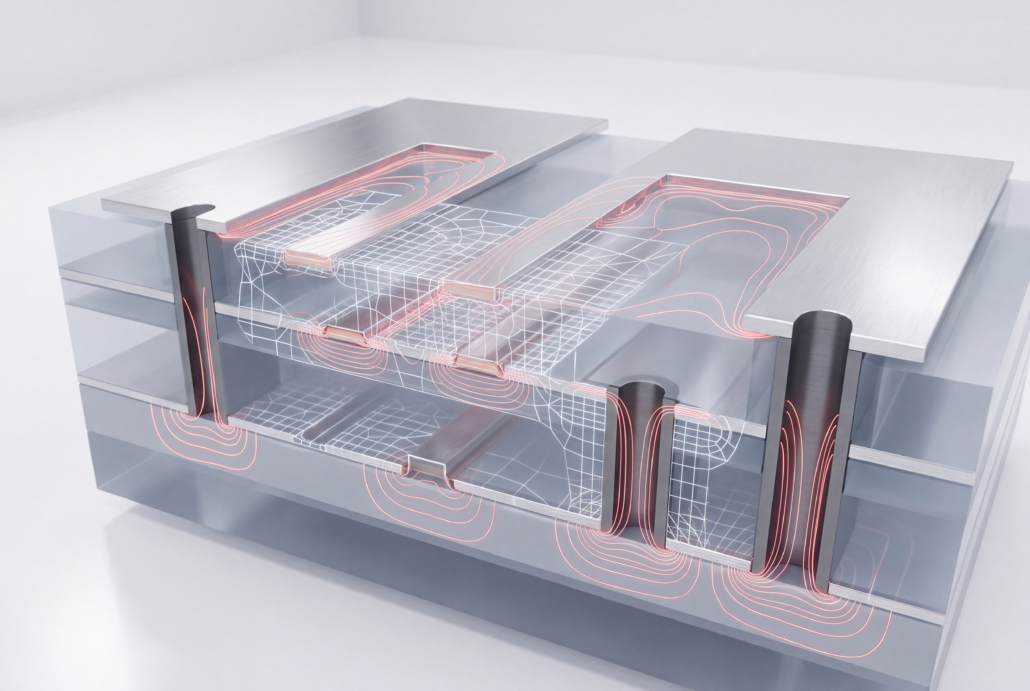
Victory RCx: 3D field-solver parasitic extraction

Victory RCx extracts resistance and capacitance from the 3D structure your process actually builds, etched sidewalls included, so the parasitic extraction you hand to circuit simulation is an answer, not an estimate.

What Victory RCx does

Victory RCx is a physics-based field solver that extracts parasitics in three dimensions. It works on structures of any shape, including the etched and deposited profiles from process simulation. It’s built for detailed work at cell level. You choose the accuracy, and the mesh adapts to reach it. The output is a SPICE netlist. Full-chip runs stay with Hipex’s rule-based extractor, while Victory RCx takes the cells whose shape a rule deck can’t describe.

Capabilities

Field solver

Resistance and capacitance are solved from the physics on the full 3D geometry, with nothing looked up from a pre-characterized pattern. You pick from several solvers and set the solution tolerance, material properties and boundary conditions yourself.

Structure handling

The solve includes floating and dummy conductors. Capacitance from a single conductor is split across every region it couples to, so you can see where it goes. Simple Manhattan geometry can be built inside the tool. For curved, non-planar shapes, the structure comes straight from Victory Process with its simulated etch and deposition intact.

Advanced node

Victory RCx analyzes gate-contact capacitance in the FinFET middle end of line. That geometry is dense and fully three-dimensional. Rule-based extraction can fall short there, and the LPE deck you’d need may not exist yet.

Display and optical

Display work gets more than RC. The solver takes optical devices, LCD and touch-panel structures. An LCD physics model with voltage-dependent permittivity tracks how capacitance and liquid-crystal director orientation shift with bias. Sweep wavelength and pixel voltage to see a cell’s transmittance, reflectance and contrast. Then check its transient response as the light source switches.

Output

Parasitics come out as a standard SPICE netlist, so they drop straight into the circuit simulator you already run. Tighten the tolerance and the adaptive mesh refines only where it has to. Relax it and the run finishes sooner.

Where it sits in the TCAD flow

In: a simulated 3D structure from Victory Process, refined in Victory Mesh when it needs it.
Out: a SPICE netlist for circuit simulation. On the design side, Hipex-FS runs the same solvers from
inside the Expert layout editor.

In

3D structure

This tool

Victory RCx

Solves R and C

Out

SPICE netlist

Circuit simulation

Alongside

Hipex-FS

Same solvers, in the Expert layout editor

Where 3D parasitic extraction pays off

Advanced CMOS

FinFET, SOI and bulk CMOS, including middle-end-of-line and back-end-of-line parasitics.

Display

TFT backplanes, LCD cells and touch panels. Silvaco TCAD is in use at eight of the ten biggest display manufacturers.

Journal article · Simulation Standard, 2016

Using Victory Process to Create Realistic Structures for Capacitance Extraction in Clever

Importing a simulated Victory Process structure for field-solver extraction. Clever is Victory RCx's earlier name.

Worked example

Field Solver (Victory RCx) mode of Hipex Parasitic Capacitance Extraction

Runs the solver from inside Expert on a sample layout, step by step.

Presentation · 2022

Parasitic Extraction Victory RCx Pro and Hipex FS – Integrated Full Chip and Cell Level RCX Combine Rule Based and Field Solver Solutions

Presentation

Parasitic Extraction – Full Chip and Cell Level RC Extraction

Product brief

Victory RCx Pro – RC Extractor for Realistic 3D Structures

Webinar · 2018

Accurate Parasitic RC Extraction using Realistic 3D TCAD Structures

Evaluate Victory RCx or get support

Evaluating Victory RCx

Bring a cell you've already extracted with a rule deck or checked against measured silicon. Our technical experts can tell you whether a field solve changes the answer on that geometry, before you commit time to a formal evaluation.

Already running it

Installers and documentation live in Support and Downloads, next to the installation guide and supported operating systems.

Stuck on something

Open a case in the support portal and track it there. Access comes with a current maintenance contract.

Parasitic extraction questions

What is 3D field-solver parasitic extraction?

It means computing a structure's parasitic resistance and capacitance by solving the electric field inside its real 3D geometry, where a rule deck would look the values up. The structure is meshed in three dimensions, so curved sidewalls and floating conductors count toward the answer.

When the geometry is too detailed for a rule deck to capture accurately, or when no LPE rule deck exists for your process yet. Middle-end-of-line FinFET structures and realistic etch profiles are the usual examples. For full-chip extraction, rule-based tools remain the practical choice.

Both use the same field solvers, but they start from different places. Victory RCx works on 3D structures from process simulation, on the TCAD side. Hipex-FS starts from a layout inside the Expert editor, and Hipex-RC is Silvaco's rule-based extractor for full-chip jobs.

Yes, it extracts directly from the 3D structure Victory Process builds, with the etched and deposited shapes as simulated. Victory Mesh can refine that structure's mesh before extraction. For square-sided Manhattan shapes, you can skip the process run and build the structure in Victory RCx itself.

Yes. Capacitance between a FinFET's gate and its contacts, in the middle end of line, is one of the analyses Victory RCx runs. Those values then go into SPICE, so you can simulate their effect on the circuit before anything reaches silicon.

A SPICE netlist. Any circuit simulator that reads SPICE can take the extracted parasitics, so they fit the flow your team already runs. Precision and runtime trade against each other, and the tolerance you set decides where each run lands.

More Silvaco TCAD tools

Victory Process

Victory Device

Utmost IV

Victory Atomistic

Victory Mesh