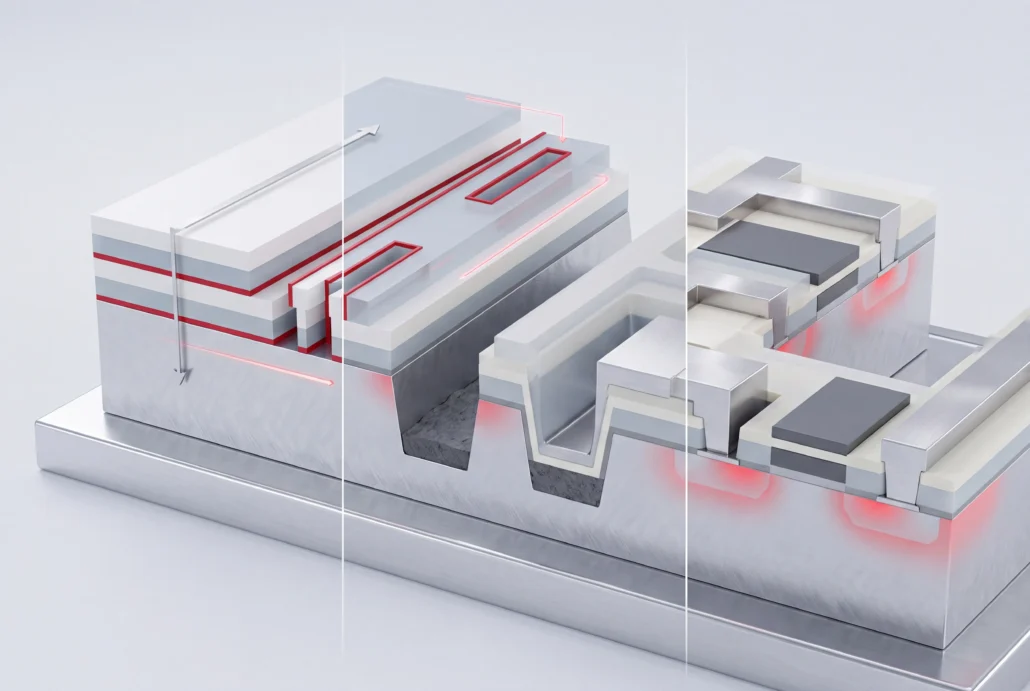
Computational lithography and Process Proximity Compensation
Lithography simulation, proximity correction and model calibration, fitted to your measured wafers. The mask you release prints the pattern you drew, and the first wafer run confirms it.
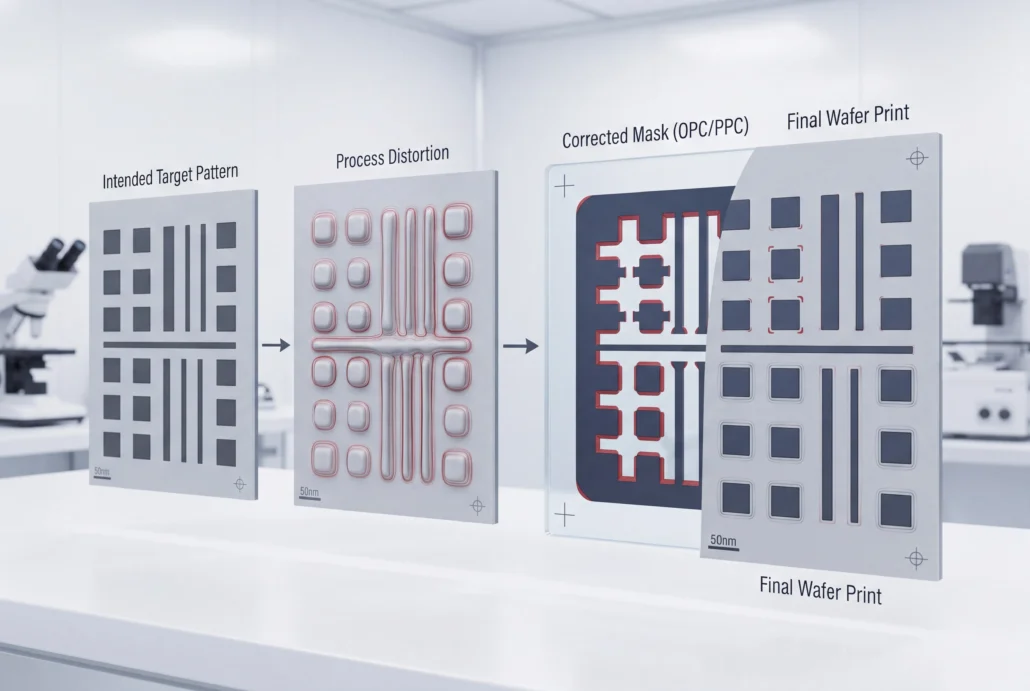
Computational lithography is the software that predicts how a mask pattern will print on a wafer and changes the mask so the printed result matches the design. Process proximity Compensation is its core step. It models how exposure, resist and etch distort each feature, shifts mask edges to offset that distortion, then checks the corrected mask in simulation.
The problem
The wafer doesn’t print what you drew. Below the exposure wavelength, diffraction, resist and etch each drag an edge off target. Lines thin. Corners round. Line ends pull back. A perfect layout can still produce the wrong silicon.
What the software does
It predicts that drift with a model calibrated on your silicon, corrects the layout, and simulates the result back before any data reaches the mask shop.
When you use it
When you qualify a new node and need to know whether a layer can print at all. At tape-out, on every critical layer. And in a yield ramp, when one layer keeps missing its critical dimension and nobody can say why yet.
Process Proximity Compensation (PPC)
Silvaco added Process Proximity Compensation from Cadence in March 2025. DimensionPPC handles curvilinear masks.
Process Proximity Compensation (PPC)
Builds and verifies the mask your layout needs.
Third-generation suite designed for correct-by-construction OPC, with patented optimization
Source and source-mask optimization with hybrid SRAF placement
Pipelined, distributed runs on general-purpose hardware; recipes by GUI or script
What it runs on, and what it runs against. Where nothing is published, this says so.
Foundries and nodes
PPC runs in production from large geometries to the most advanced processes. The PDK table covers Silvaco’s analog and custom IC tools; ask us directly about lithography coverage.
Lithography settles which shapes reach the wafer. TCAD process simulation picks them up from there, through etch, deposition and implant, and into a working device.
Micron's curvilinear OPC work on DRAM layers, using DimensionPPC.
Licensing and support for lithography tools
The questions that come before a purchase order. Where the published answer covers the other product families but not this one, that is said rather than glossed.
Licensing options
Time-Based Licensing: floating seats on terms of one to three years, with updates and technical support in the fee.
Process proximity compensation (PPC) makes a printed feature match its drawing. Exposure, resist and etch each move a feature's edges, so a line never prints exactly as drawn. PPC predicts that movement and pre-distorts the mask by the opposite amount.
How is PPC different from OPC?
Optical proximity correction (OPC) corrects for what the optics do during exposure. PPC also accounts for resist, etch and mask effects, which shift the final dimension too. Silvaco's Process Proximity Compensation is an OPC suite whose process model covers that wider set, so it corrects toward the dimension you'll measure.
What is computational lithography used for?
Computational lithography makes sub-wavelength features print correctly, which at an advanced node means every critical layer. Teams rely on it while qualifying a node, while preparing mask data for tape-out, and when a yield ramp stalls on a layer that won't hold its dimension.
How is a lithography model calibrated?
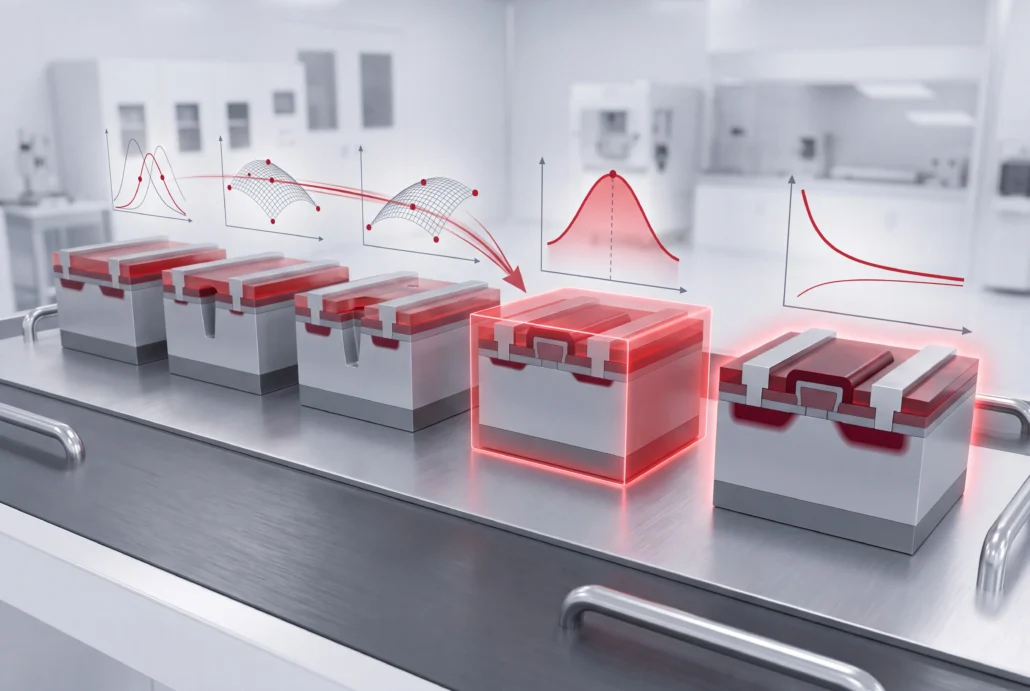
Against your own measurements. You print test patterns, measure them with CD-SEM or other metrology, and adjust the model until its simulation reproduces the wafer. Silvaco's predictive process model fits resist, etch and mask behavior this way, so it describes your process, not a generic one.
How does lithography connect to Silvaco TCAD?
They sit on either side of the same wafer. Lithography sets the printed pattern; Silvaco TCAD, including Victory Process, models what the fab does to it next. Both belong to Silvaco's AI-Driven Manufacturing unit alongside FTCO, solution platform
Which foundries and nodes are supported?
Silvaco's PDK table lists support for its analog and custom IC tools. Lithography sits outside it, so for a mask flow the useful question is whether your layer type has been corrected before. Ask us that.
Can it run on a GPU?
Published so far: PPC distributes synthesis and verification across general-purpose hardware. Share your cluster size and layer count and we'll size a run for you.
Is it available for university research?
Silvaco's University Program licenses its tools to more than 200 universities for research and teaching, separately from commercial sales. Contact the program with your group's project to check.