Automotive Semiconductor
Automotive semiconductor: power train, display and safety-critical IC development
Every automotive chip has to survive the vehicle and hold up in its safety case, so Silvaco gives you device simulation and automotive IP for the power train, the cabin display and the safety-critical SoC.
What a vehicle asks of its chips
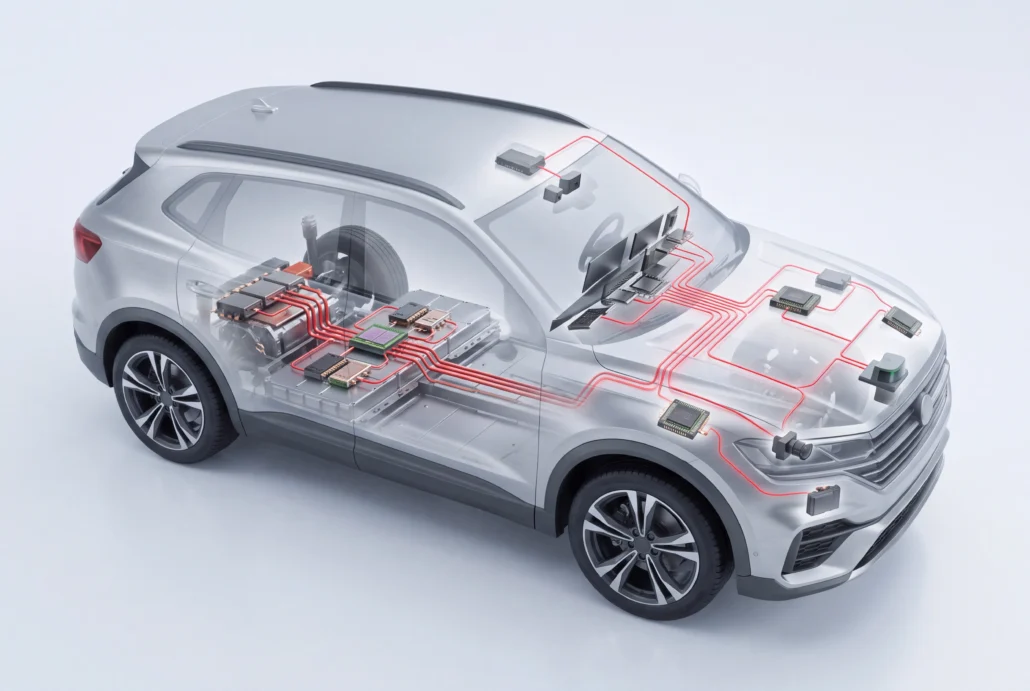
Automotive semiconductor content splits into three engineering problems that rarely share a team. Power conversion in the electric and hybrid drivetrain. Displays in the cabin. And the SoCs and control units that run the rest of the car, talking to each other over CAN, LIN and FlexRay.
A phone chip can be tuned for the average case. A vehicle chip gets judged on the worst one. Your part has to keep working through heat and electrical faults for the life of the car. Any function that touches safety also needs an ISO 26262 argument, graded ASIL A through ASIL D. That changes how you simulate the device, and what evidence your IP supplier owes you.
Three routes into the vehicle
Start from the part you’re building. The device simulation and the IP come from one
vendor, so a program that spans all three has one supplier to qualify.
Power train
Take SiC, GaN and silicon drivetrain devices from process concept to a SPICE model. The TCAD power device flow hands your circuit team a model it can use.
Victory Process: 2D and 3D virtual fabrication
Victory Device: electrical, thermal and reliability simulation
Utmost IV: SPICE model extraction
SmartSpice: circuit validation
Cabin display
Develop OLED, TFT, LCD and microLED panels for the dashboard and cabin. Device physics, circuit simulation and extraction run in one display flow.
Victory Device: TFT and emitter device physics
SmartSpice: Silvaco’s four-terminal TFT model
SmartSpice Pro: Scell and full-panel simulation
Hipex: cell and full-panel extraction
SoCs and control systems
License Design IP that’s already running in volume production, including controllers built for your functional safety case.
Automotive IP: Controllers for CAN, CAN FD, LIN and FlexRay, Proven in Use in production vehicles
MIPI IP: Mixel’s ASIL-B D-PHY CSI-2 transmitter and receiver, with ISO 26262 process and product certifications
Technologies and devices
Each device area has its own physics. Qualification and functional safety cut across all of them.
Power train
Diodes, SiC MOSFETs and GaN HEMTs for electric and hybrid drivetrains. Each one is simulated as a process and as a device. It leaves as a compact model before you commit a wafer lot.
Cabin display
Cabin panels on a-Si, LTPS or IGZO TFT backplanes, carrying OLED, LCD or microLED, and verified at full-panel scale.
SoC and control systems
Silvaco’s in-vehicle network controllers cover CAN, CAN FD, LIN and FlexRay, with more than a billion units behind them. You set each one’s gate count through the configuration you choose. For cameras and radar, Mixel’s ASIL-B MIPI D-PHY CSI-2 IP already sits inside automotive radar processors.
Qualification and functional safety
Find the weak point in simulation, before qualification testing finds it on silicon. TCAD shows how your device behaves at temperature, as it self-heats and as it ages. It also covers unclamped inductive switching outside the safe operating area.
On the IP side, the evidence ships with the block. The networking controllers count as Proven in Use under Part 8 of ISO 26262. Mixel’s MIPI IP comes with a safety manual and functional safety deliverables. It’s designed to support AEC-Q100 Grade 1.
Applications
From the traction device to the safety case.
Electric and hybrid vehicle power electronics
Traction-side SiC, GaN and silicon devices, modeled with material-specific physics.
In-vehicle display development
Dashboard and cabin screens, built up from the TFT backplane.
Automotive SoC and ECU design
Network controllers and camera interfaces for the automotive SoC inside each control unit.
Functional safety qualification
Reliability checked in TCAD, and IP that arrives with its ISO 26262 evidence.
The record behind the IP
Your safety case is only as strong as the evidence behind each block. Start with the record.
1 billion+
automotive networking IP units shipped
ISO 26262 Part 8
Proven in Use, automotive networking controllers
ISO 26262
Mixel process and product certifications, first announced in 2021
ASIL-B
Mixel MIPI D-PHY CSI-2 transmitter and receiver
Customer · Automotive radar
February 2022
indie
Integrated Mixel's ASIL-B MIPI D-PHY CSI-2 TX and RX IP into its automotive radar processors and MMICs. A safety manual and certified safety deliverables came with it.
“We needed a MIPI IP provider that could support our strict automotive requirements to further our radar portfolio and enable efficient and scalable ADAS architecture solutions.”
Peter Gulden, EVP Radar Systems and Software, indie
Customer · In-vehicle networking
February 2022
Faraday Technology
Chose Silvaco's FlexCAN IP as the networking backbone for its latest automotive ASIC. The controller complies with ISO 11898-1 and supports CAN FD.
“Silvaco’s industry-proven FlexCAN IP efficiently supports our pursuit of innovation and excellence.”
C.H. Chien, VP of R&D, Faraday Technology
Webinar
February 2022
Silvaco SIPware Automotive IP
The automotive communication IP portfolio, the standards it meets, and where it sits against ISO 26262 safety integrity levels.
Article · Qualification
February 2022
TCAD Mixed-Mode Simulation for GaN Power HEMTs in Unclamped Inductive Switching
Why a GaN power HEMT's ruggedness outside the safe operating area belongs in qualification, and how to simulate it.
Tell us what has to survive the vehicle
A traction device, a cabin panel or a safety-relevant SoC? Name the part and the safety level it
needs. Our engineers will point you to the flow or the IP that fits, with the safety evidence behind
it.
Questions about automotive semiconductor development
What is different about automotive semiconductor development?
The vehicle sets a harder bar than consumer electronics. Parts face heat, self-heating and electrical faults over a long service life, and safety-relevant functions must fit an ISO 26262 case. So reliability work starts in TCAD, and IP gets chosen for its safety evidence as well as its function.
What is ISO 26262 and how does it affect IP selection?
ISO 26262 is the functional safety standard for road vehicles, grading safety functions from ASIL A, the least demanding, to ASIL D, the most. For IP, selection becomes a question of evidence. That means a service record accepted under Part 8 Proven in Use, or certified development processes with a safety manual and deliverables.
Which Silvaco tools cover automotive power electronics?
The TCAD power device flow covers them end to end. You build SiC, GaN or silicon devices in virtual fabrication, simulate their electrical, thermal and reliability behavior, then extract a SPICE model and check it in a circuit. Victory Process, Victory Device, Utmost IV and SmartSpice handle those four steps.
How are in-vehicle displays developed?
The same way as any modern display: pixel device first, verified panel last. Engineers simulate the TFT backplane and the emitter and extract compact models, then simulate, lay out, extract and verify the full panel. Silvaco's display flow covers a-Si, LTPS and IGZO TFTs alongside OLED and microLED emitters.
What automotive IP is available?
Two families. Automotive networking IP covers CAN, CAN FD, LIN and FlexRay through controllers that hold ISO 26262 Proven in Use status, and over one billion units have shipped to date. From Mixel, a Silvaco company, MIPI IP includes an ASIL-B D-PHY CSI-2 TX and RX pair, already integrated into automotive radar processors.
How is a device qualified for the automotive environment?
On silicon, against stress tests such as AEC-Q100 for integrated circuits. TCAD gets you ready by showing where a device weakens at high temperature or under unclamped inductive switching, so you fix weak points before any parts exist. For IP, Mixel's MIPI blocks target AEC-Q100 Grade 1.