XSim Photonics
Home » Products & Workflows Hub » AI-Driven Manufacturing » Photonics » XSim Photonics
XSim Photonics: electromagnetic and photonic device simulation
See how light and RF energy move through your waveguides, resonators, couplers and antennas, and test each design choice before it reaches a mask.
What XSim Photonics does
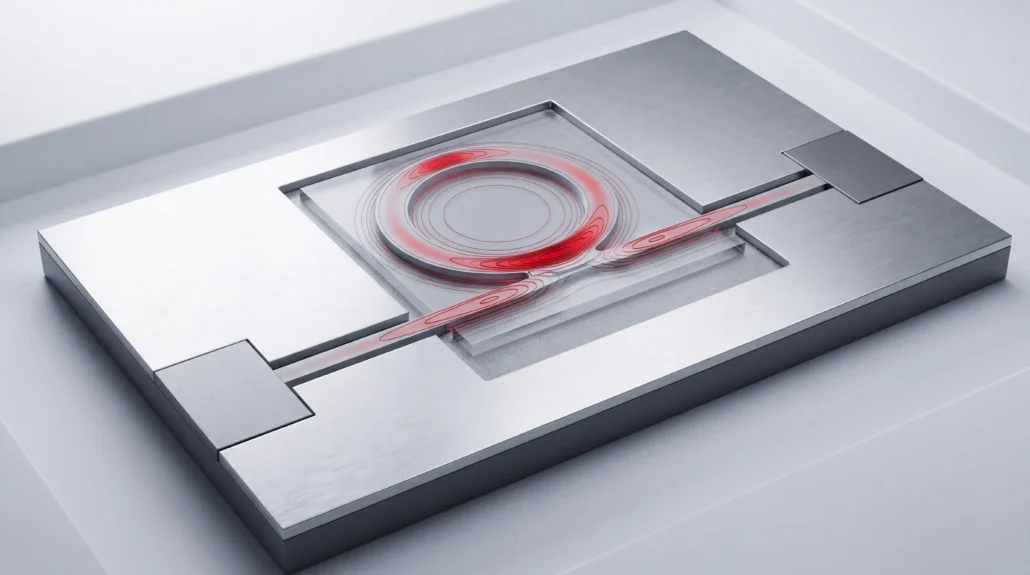
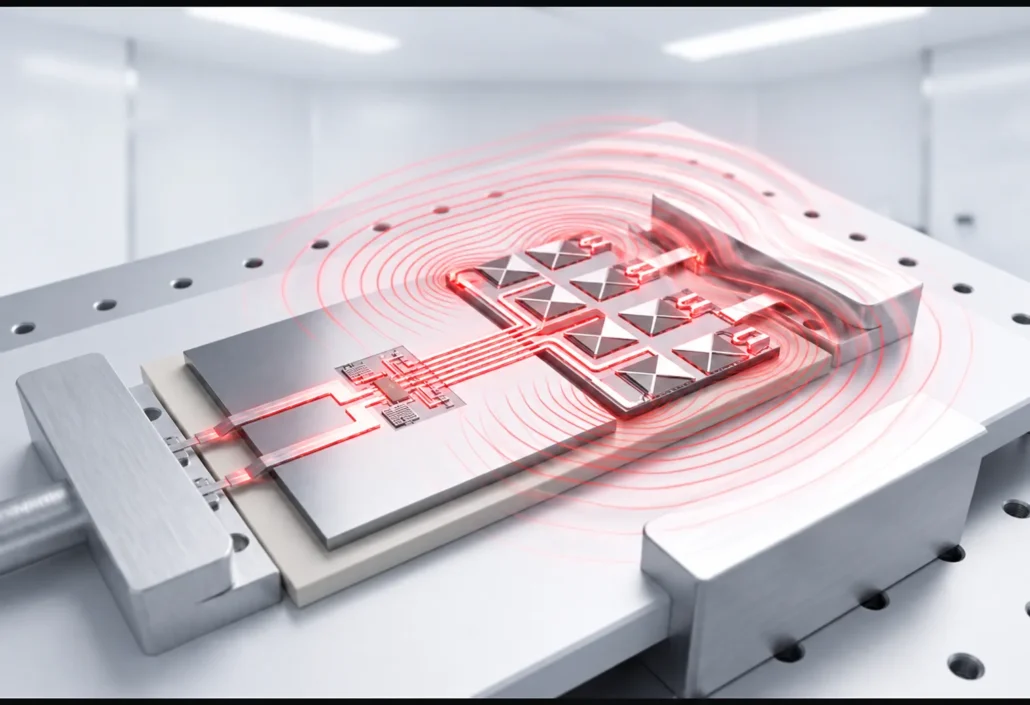
XSim Photonics is an electromagnetic solver for photonic and RF devices. It handles waveguides and other photonic integrated circuit components through to antenna arrays, on x86 CPUs or NVIDIA GPUs. You bring the geometry and the materials. You get back S-parameters and far-field results, the numbers that decide whether a component goes to tape-out as drawn.
Capabilities
Computational
Constant or variable gridding, driven by broadband or monochromatic sources. Conformal conductors, dispersive dielectrics and resistive materials, so a curved or lossy structure is modeled as drawn. Phase-shifted periodic boundaries, adiabatic absorbers, launch and exit ports, and a total-field / scattered-field source cover periodic, open and port-driven problems.
Workflow and setup
One interface takes you from setup to visualization, and you can script every step. Import GDS, STEP or STL geometry, or build it in the Composer 3D geometry builder. Pick materials from the library or define your own. A mode solver sets up the guided modes you launch, and monitors go wherever you need the data.
Computing platforms
Runs on x86 CPUs and NVIDIA GPUs, and distributes the computing across either when one machine isn’t enough. Windows, Linux or Mac, from a laptop to a supercomputer, or on AWS using the Tech-X CloudCompute service.
Analysis and output
S-parameters against wavelength, the form a circuit-level simulation needs for a passive photonic component, and far-field transformations for anything that radiates. Inside the structure, 3D visualization with slicing and contours, Fourier transformation and regional energy analysis show you where the energy goes.
Works with
Takes in
a GDS layout, a STEP or STL model, or geometry built in Composer, plus the materials you assign to it.
Produces
S-parameters and far-field results you can analyze per component, or drop into a circuit-level simulation as blocks.
What you can simulate
Photonic integrated circuits
Characterize each component as S-parameters, then assemble the circuit from them.
Waveguides, modulators, resonators and couplers
See where light couples, leaks or reflects in each part of the chain.
Antenna arrays and RF components
The same electromagnetic solve at gigahertz scale: radiation and far fields for antennas and arrays.
Component-level electromagnetic analysis
Scattering and field behavior in any component whose electromagnetic response decides whether it works.
Where XSim Photonics already runs
XSim came to Silvaco with Tech-X in 2025, along with Tech-X’s work on multi-node GPU simulation for photonics.
Send us the component that
didn't measure the way it simulated
XSim Photonics questions
What does XSim simulate?
Photonic and RF devices. For photonics, that means integrated circuit components such as waveguides, resonators, couplers and modulators. For RF, it means antennas, antenna arrays and other RF components. XSim Photonics also handles general component-level electromagnetic problems, and returns S-parameters and far-field results for all of them.
Which solver does XSim use?
Conformal conductors and dispersive dielectrics represent curved and lossy structures as drawn, and a mode solver sets up the guided modes you launch. Broadband or monochromatic sources let you cover a whole wavelength range or check a single wavelength.
Can XSim import a GDS layout?
Yes. XSim imports GDS layouts as well as STEP and STL models, so the geometry you've already drawn is the geometry you simulate. No file yet? Build the structure in the Composer 3D geometry builder. Either way, it goes through the same setup, materials and monitors.
Does XSim run on GPUs or in the cloud?
Both. XSim runs on x86 CPUs and NVIDIA GPUs, and can distribute a run across either, on anything between a laptop and a supercomputer. For cloud runs, the Tech-X CloudCompute service puts XSim on AWS. The documentation lists the GPU and memory a given problem size needs.
What is the difference between XSim and TCAD optical simulation?
Different questions. Silvaco's TCAD optoelectronics tools model light inside the device: image sensors, solar cells, lasers and optical sensors. They follow what the light does to the device's electrical behavior. XSim works on the light itself: how it travels through a component and what comes out the other end.
Is there an evaluation?
Yes. Talk to our Technical Experts with the component, layer stack and wavelength range you want to test, and the workstation or cluster you'd run it on. They'll scope the evaluation with you. University research groups apply through the University Program instead; more than 200 universities already run Silvaco tools that way.