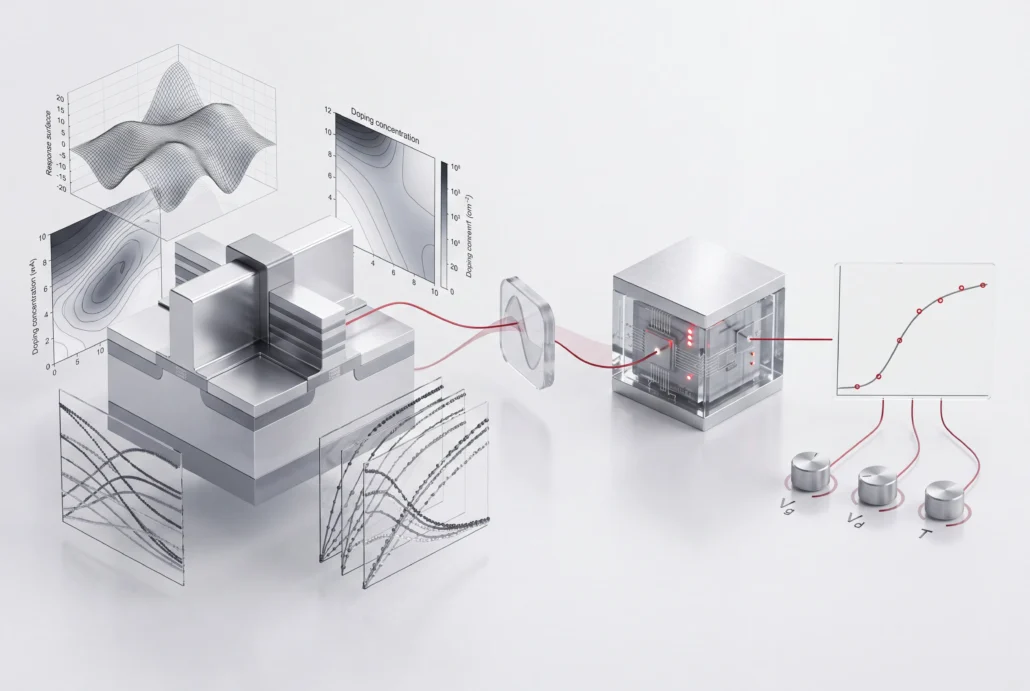
Surrogate Modeling
Surrogate Models for Real-Time Engineering Decisions
What surrogate models change for your team
Surrogate models make simulation-derived engineering knowledge accessible beyond simulation specialists. Process, integration, and design engineers can explore engineering decisions, evaluate alternatives, and investigate trade-offs in real time without launching a new simulation campaign or waiting for simulation expertise and support.
Traditional DOE studies provide a finite set of simulation results. Surrogate models go beyond those discrete points by learning the underlying engineering relationships. Engineers can therefore investigate scenarios, parameter combinations, and operating conditions that were not part of the original simulation campaign, turning a collection of simulation results into an interactive engineering model.
The underlying physics-based simulations remain the foundation. However, surrogate models extend the reach of that expertise across the organization, allowing more engineers to benefit from simulation-derived insight and make informed decisions faster.
Three kinds of surrogate model
Structure surrogate
Interactively explore how process variations affect final device geometry. Change process conditions and the predicted structure updates in real time, enabling rapid evaluation of structural outcomes without running new process simulations.
Parametric surrogate
Predict engineering metrics from process, design, and operating parameters. Use it for sensitivity analysis, process capability studies, target-driven exploration, and multi-response optimization across a broad engineering space.
Curve surrogate
Predict complete response curves in real time, e.g., IV curves. Engineers can evaluate full device or process behavior across operating conditions, including conditions that were not explicitly simulated in the original DOE campaign.
Applications
What engineers use a finished surrogate for.
Process parameter exploration
See which process parameters move the result you care about, as you change them.
Design targeting
Give the model a target and get back the process values that reach it.
Variation and yield studies
Run Monte Carlo and Cp or Cpk analysis on the model before variation shows up on production wafers.
TCAD-derived behavior for non-TCAD engineers
Fab-side and design teams get physics-based answers with no simulator to learn.
Evidence and resources
Want to see a surrogate built from start to finish? Start with the August webinar.
Webinar
Manufacturing-Aware PIC Simulation Webinar FTCO & Digital Twins
Modern semiconductor development requires rapid exploration of large design spaces while maintaining the predictive accuracy of physics-based simulation.
Webinar
TCAD-Aware SPICE Model Extraction with Utmost IV: From Manufacturing to Surrogate Circuit Modeling
Accurate compact models are essential for translating device behavior into trustworthy circuit simulation,
Customer evidence
February 2022
Micron Technology and FTCO
Micron's production-scale digital twin work with Silvaco is documented on the FTCO page.
Webinar
February 2022
AI-Powered Surrogates: From Process Geometry to I‑V Curves
Dr. Christian Caillat, CAE Manager at Silvaco, takes FTCO simulation data through to structural and electrical surrogates, then shares them as XML model cards.
Article · Power devices
February 2022
Accelerating Next-Generation Power Technologies with AI-Powered FTCO
How FTCO pairs large simulation runs and designed experiments with machine-learning surrogates to speed up wide-bandgap power device development.
Webinar · Power devices
February 2022
Accelerating Next Generation Power Technologies
Case studies on SiC DMOS, vertical GaN and p-GaN HEMTs, each optimized with calibrated TCAD feeding machine-learning surrogates.
More on foundry enablement
Every surrogate starts with a question
someone keeps asking
Which process or device question does your team ask every week, and who waits for
the answer? Our engineers will tell you whether a surrogate fits it and what building one would
take.
Questions about surrogate modeling
What is a surrogate model?
A surrogate model is a fast approximation of an expensive simulation, trained on results that simulation has already produced. In semiconductor work, you adjust a process parameter and it returns the structure, device metrics or full I–V curve the simulation would have given. The answer comes back in real time.
Who creates a surrogate model and who uses one?
A simulation expert (e.g., TCAD engineer) creates it by planning a set of simulations, running them and fitting a model to what comes back. Engineers without simulation expertise, e.g., Pprocess, integration and design engineers, use it. They query the finished model to explore process parameters and find the values that hit a target. No simulation runs on their side, and nobody waits on a simulation specialist.
What accuracy can a surrogate model be trusted to?
Inside the range its training runs covered, a surrogate tracks the simulation it learned from. Outside that range it still returns answers, but they're extrapolations, and any systematic error in the training data carries straight through. Check it against measured silicon before you rely on it.
Does using a surrogate model require a TCAD license?
No. Creating a surrogate takes TCAD and a trained specialist. Using a finished one takes neither. Your TCAD team builds and validates the model, then shares it as a model card, an XML file that engineers without TCAD can query in real time.
What data is needed to train one?
A designed set of simulations that samples the parameter range you care about, Coverage matters more than the fitting method. Calibrating the simulations to silicon first, is what lets you trust the model against real devices.