Utmost IV
Home » Products & Workflows Hub » AI-Driven Manufacturing » TCAD » Utmost IV
Utmost IV: device modeling and SPICE model extraction
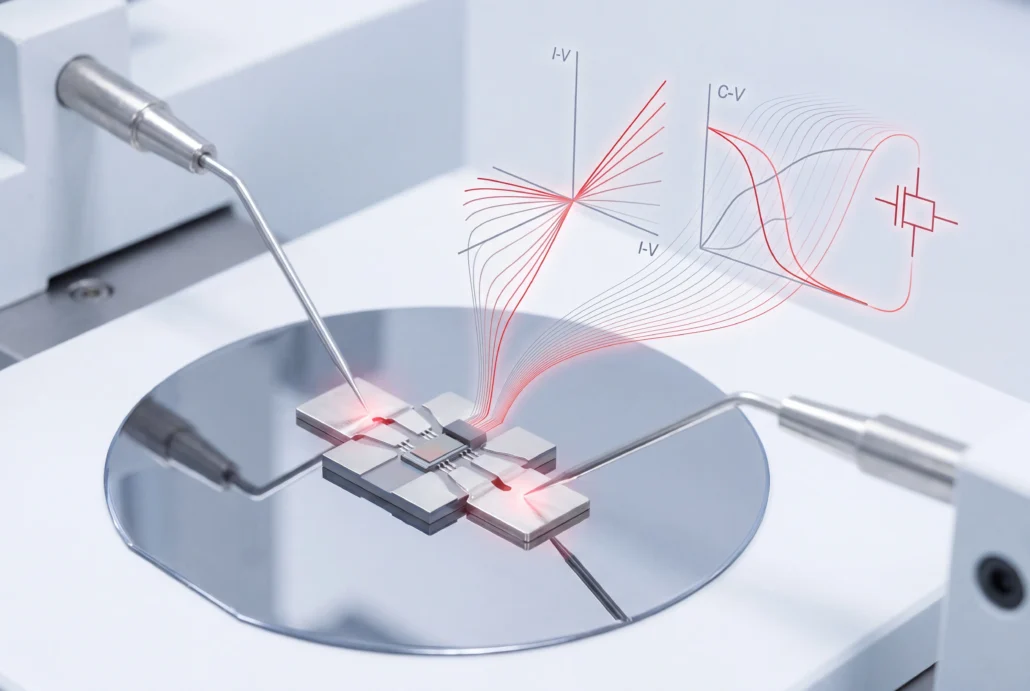
Utmost IV builds the compact models your circuit team simulates with, from device data you measured on the bench or simulated in TCAD.
What Utmost IV does
Utmost IV measures or simulates device characteristics and extracts the SPICE compact models that circuit designers and PDKs depend on, from BSIM-CMG and BSIM4 through HiSIM and PSP. It fits each model from a pre-configured template and checks the result across process corners before anything reaches a design kit. It’s the device modeling step between your TCAD work and your circuit team’s simulations.
Device modeling capabilities
Data acquisition
High-speed acquisition engines run the measurement for you, so characterization is a scripted job rather than sweeps set by hand. The drivers are open architecture. Edit the ones Silvaco ships, or build one for whatever instrument sits on your bench.
Extraction
Every supported model type starts from a pre-configured template with physics-driven initial parameter estimates, so the fit begins close to the answer. AI and machine-learning optimizers work alongside eight mathematical ones, from Levenberg-Marquardt and Hooke-Jeeves to particle swarm and Gaussian process. Feed them TCAD results or measured devices. Silvaco puts model creation at minutes where it used to take weeks.
Model library
BSIM-CMG, BSIM4 and BSIM6, HiSIM and PSP, plus RF, power MOSFET and reliability models. The library reaches multi-finger, FinFET and GAAFET devices as well as emerging architectures. When no standard model describes your device, write it in Verilog-A or build a macromodel.
Workflow
Design of experiments decides which measurements are worth your time. Extraction follows, then statistical analysis and corner validation, with reliability, aging and temperature checks in the same pass. When the process moves, you iterate the model instead of starting over.
Verification and deployment
A multi-threaded SmartSpice interface puts every model through a full SPICE simulation before release, so the fit is tested in a simulator as well as in the tool that produced it. Your designers can use it in SmartSpice, HSPICE, Eldo, Spectre, LTspice or QSPICE, inside a Cadence, Synopsys or Mentor environment. Utmost IV itself runs on premises, on HPC clusters or in the cloud, on Windows or Linux.
Where it sits in the TCAD flow
Victory Process builds the structure and Victory Device solves it. Utmost IV turns that
result, or your measured silicon, into a model a circuit simulator can read.
In
Characteristics
Measured silicon, or simulated from Victory Device
SPICE model extraction, from the design side
If you design circuits, you’ll rarely open Utmost IV. Every simulation you run still inherits its models. A corner nobody extracted stays invisible until silicon fails at it, which is why extraction here ends in verification rather than in a good-looking curve fit.
Who runs Utmost IV
Foundry PDK teams
Build the kits every customer designs against, and keep them current
Power device modeling
SiC, GaN and silicon power parts, with models validated across temperature
Advanced-node FinFET and GAAFET modeling
BSIM-CMG across multi-finger architectures
Proof and resources
Read any of it without an account.
Customer
June 24, 2025
Fraunhofer ISIT
Uses Victory TCAD, Utmost IV and SmartSpice together as a DTCO flow for GaN and MEMS work on 8-inch wafers, through its part in the EU Chips Act's APECS pilot line.
“Especially during our current development of high voltage lateral and vertical GaN devices based on engineering substrates … we see many physical effects that require accurately calibrated process and device models.”
Michael Mensing, Ph.D., Head of the Advanced Devices Group
Customer
May 6, 2025
Excelliance MOS
Adopted a DTCO flow of Victory TCAD and Utmost IV for its silicon carbide power devices, with Utmost IV automating the electrical measurements and extracting the SPICE models.
“With Silvaco’s DTCO flow combining Victory TCAD and UTMOST IV, we can simulate, analyze, and refine device performance … helping us bring innovative power solutions to market more rapidly.”
Fermi Liu, Director of R&D Department
Published paper
February 2013
A Sequential Model Parameter Extraction Technique for Physics-Based IGBT Compact Models
Dondee Navarro, Takeshi Sano and Yoshiharu Furui, all Silvaco engineers. IEEE Transactions on Electron Devices, Vol. 60, Issue 2, pp. 580–586. A step-by-step method for extracting the parameters of physics-based IGBT compact models.
Published papers
Masataka Miyake, Dondee Navarro, Uwe Feldmann, Hans Juergen Mattausch, Takashi Kojima, Takaoki Ogawa and Takashi Ueta, “HiSIM-IGBT: A Compact Si-IGBT Model for Power Electronic Circuit Design,” IEEE Transactions on Electron Devices, Vol. 60, Issue 2, pp. 571–579, Feb. 2013
Dondee Navarro, Takeshi Sano and Yoshiharu Furui, “A Sequential Model Parameter Extraction Technique for Physics-Based IGBT Compact Models,” IEEE Transactions on Electron Devices, Vol. 60, Issue 2, pp. 580–586, Feb. 2013
Isato Ogawa, Tomoharu Yokoyama and Mutsumi Kimura, “Simulation of neural network using ferroelectric capacitor,” IEICE Technical Report Vol. 117 No. 372, No. 373, Dec. 2017
Webinars
Evaluate Utmost IV, or get help with it
Evaluating Utmost IV
Bring one device's measurements, or TCAD results if there's no silicon yet, and tell us which model type you need.
Teaching or doing research? The University Program is how 200+ universities license Silvaco tools.
Already running it
Installers, release notes and user manuals sit under Support and Downloads.
Stuck on something
With a current maintenance contract, you open a case in the support portal and track it there. Raise instrument-driver and model-convergence questions early.
Device modeling questions
What is SPICE model extraction?
SPICE model extraction gives a circuit simulator the parameter set it needs to reproduce a real device. You gather the data by measurement or simulation, then tune a standard model such as BSIM, HiSIM or PSP until its curves match. The design team receives the parameters, not the raw data.
Which compact models does Utmost IV support?
BSIM-CMG, BSIM4 and BSIM6, HiSIM, PSP, RF models, power MOSFET models and reliability models, along with macromodels and Verilog-A. Multi-finger, FinFET and GAAFET devices are in scope, as are emerging architectures, so an unusual structure doesn't leave you without a model.
Can Utmost IV extract models from TCAD simulation instead of measured silicon?
Yes. Point the optimizers at simulated characteristics from Victory Device and you get a compact model before any silicon exists. When wafers come back, re-extract against the measurements with the same templates and compare the two to see how close the simulation was.
Which SPICE simulators can use the extracted models?
SmartSpice, HSPICE, Eldo, Spectre, LTspice and QSPICE, and the models load into Cadence, Synopsys and Mentor design environments. Whichever you use, the model has already run in SmartSpice before it reached your design, so you aren't the first to simulate it.
Which measurement instruments does Utmost IV support?
Any instrument you can write a driver for, because the drivers are open architecture rather than a closed list of supported hardware. Your team can adapt an existing driver to new equipment, and the acquisition engines handle the measurement run. Tell our Technical Experts which instruments you use and they'll say what the driver work involves.
How does Utmost IV fit into PDK development?
It produces the models a PDK ships, with statistical and corner variants rather than a single nominal device. Foundries and IDMs build and maintain kits with it. Fabless teams use it to check design assumptions against the models they're given.