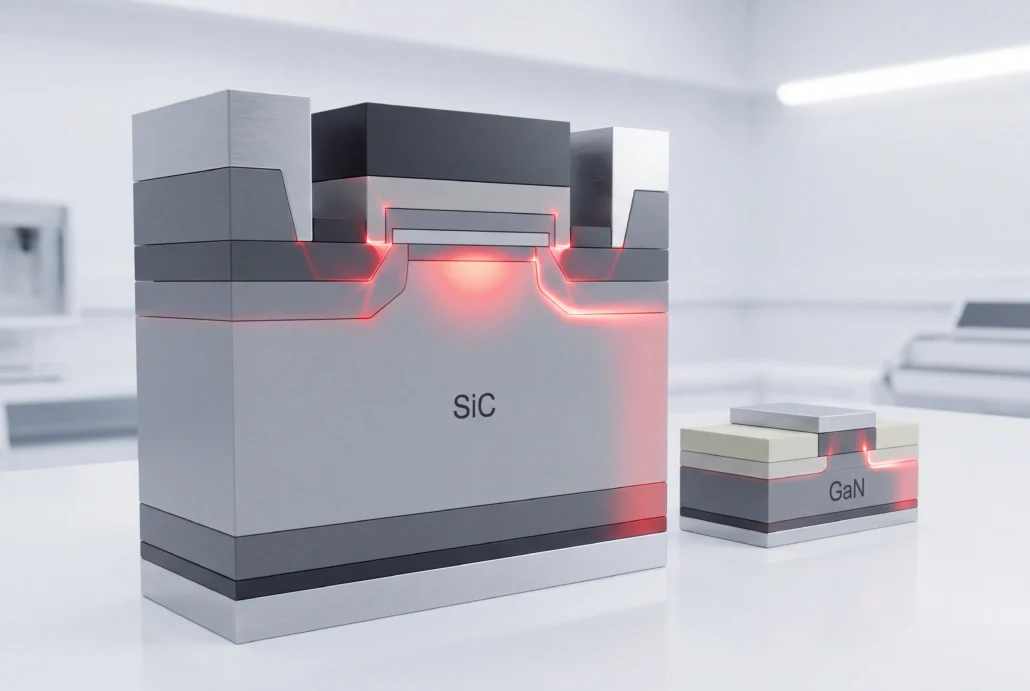
Power semiconductor devices: SiC MOSFET, GaN and silicon development with TCAD

New power devices need proof before a wafer run, and Silvaco TCAD supplies it for your SiC MOSFET, GaN HEMT or silicon IGBT, from process concept to SPICE model.

What power semiconductor teams are up against

Silicon carbide and gallium nitride are taking power electronics past what silicon can do alone. You see it in automotive, 5G, industrial, consumer, high-performance computing, and aerospace and defense designs. Whether a wide-bandgap device can work is rarely your open question now. How fast you get from a process concept to a compact model your circuit designers will trust is.

Finding that out wafer by wafer is slow and expensive. Simulation moves the learning ahead of the fab. You change the recipe, the structure or the bias on screen and see what the device does. Fewer prototypes stand between you and production. On a new SiC MOSFET, that’s the difference between an estimate and an answer.

Where Silvaco fits in your flow

Process, device, model, circuit, layout. Run all of it, or plug in only the step your team is
missing. Application engineers adapt the models, flows and tool chain to your technology where it needs it.

Input

The process concept

Recipe, device structure and target rating

01

Builds your device virtually, in 2D or 3D

02

Meshes large power structures efficiently

03

DC, AC, transient, self-heating, reliability, radiation and mixed-mode

04

Extracts your SPICE model and validates it

05

Tests the model in a circuit, down to gate charge and reverse recovery

06

Handles the rounded, complex geometry of power layouts

07

Checks those shapes without false errors

For when your question moves from one device to the whole fab. Fab Technology Co-Optimization goes beyond DTCO. It calibrates the same validated physics against fab data and builds a digital twin of your process.

Technologies and devices

Process simulation covers etch and deposition, implantation, dopant activation, oxidation and stress. An open library of
models and a material database sit behind it. Debug fast in 2D, then carry the same structure into 3D. Device
simulation runs multithreaded, with extended numerical precision for the difficult cases. You calibrate every model to your own
measured data. A new wide-bandgap material comes in by adjusting its physical parameters.

Silicon carbide and silicon

PIN and Schottky barrier diodes, DMOSFETs, JFETs, IGBTs, BJTs, thyristors and superjunction devices, each with its edge termination.

For 4H-SiC, you get the models that decide whether a SiC MOSFET holds up at high field. They include:

Gallium nitride

Schottky and PIN diodes, lateral and vertical HEMTs, MIS HEMTs, p-GaN gate HEMTs, multichannel HEMTs and superjunction devices. RF GaN has a page of its own, Wireless and RF.

GaN needs physics silicon never did:

Compact modeling

Utmost IV pulls SPICE parameters from the TCAD flow or from your measured data, then optimizes them across temperatures, wafers, die and devices. Fit DC, capacitance and S-parameter data alongside extracted values such as Vt, Idsat and ft. Build hierarchical macromodels, and tune device-model and netlist parameters together. Extraction and simulation both cover three GaN compact models.

In SmartSpice, Circuit Rubberband tunes transient behavior against time-based data: gate charge and the Miller plateau, and reverse recovery (trr and Qrr).

Layout and verification

Power layouts are full of curves. Expert draws them, repeats them and scripts the repetitive parts.

SmartDRC/LVS then runs your rule deck over those curves. Real violations get flagged, and the rounded edges don’t bury them in false errors.

Applications

From the first SiC MOSFET structure on screen to the models your circuit designers simulate with.

SiC and GaN power device development

Diodes, MOSFETs, IGBTs and HEMTs, taken from process concept to a working device while it still exists only in software.

Electric and hybrid vehicle power train devices

Hybrid and electric vehicles are one of the markets pulling power semiconductors toward SiC and GaN.

Industrial and 5G power conversion

Industrial and 5G power stages, with the operating conditions swept in simulation before anything goes on the bench.

Compact model generation for power device libraries

SPICE models extracted, validated and tuned for the libraries your circuit team designs with.

Power device teams using this flow today

A SiC device maker, a GaN connectivity company, a research institute and a power conversion specialist, each on the record.

Customer

February 2022

SemiQ

Makes SiC power devices, modules and epitaxial wafers. SemiQ evaluated Victory TCAD for process and device simulation, then made a multi-year commitment.

“With Silvaco’s prompt and expert technical support, and unique tool features specifically tailored for power devices design, we were able to quickly adopt new capabilities, such as oxidation simulation, to improve our understanding of next generation devices.”

Mike Robinson, CEO, SemiQ

Customer

February 2022

Wavetek

Develops GaN devices for 5G, Wi-Fi and IoT connectivity on Victory TCAD.

“Silvaco’s Victory TCAD platform gives us the ability to precisely model GaN device behavior under real-world conditions.”

Dr. Barry Lin, CTO, Wavetek

Research partner

February 2022

Fraunhofer ISIT

Runs Silvaco's DTCO flow on high-voltage lateral and vertical GaN devices built on engineered substrates.

“By using Silvaco’s advanced TCAD solutions, our teams can explore, understand, and optimize the performance of GaN devices with greater depth and efficiency.”

Michael Mensing, Ph.D, Head of the Advanced Devices Group, Fraunhofer ISIT

Customer

February 2022

Analog Power Conversion

Took on Victory TCAD, Utmost IV and SmartSpice as one DTCO flow for its silicon and SiC power devices.

“The integration of Silvaco’s end-to-end DTCO platform provides a unified environment to simulate, characterize, and optimize power devices, from process through circuit.”

Dumitru Sdrulla, CTO, Analog Power Conversion

Collaboration · Article

February 2022

Enabling the Rapid Development of SiC Superjunction-MOSFETs in Collaboration with mi2-factory

Superjunction structures are hard to fabricate in SiC. This article shows how simulation with mi2-factory shortens the route.

Presentation · PDF

February 2022

TCAD Power Device Development Overview for SiC and Silicon

The whole flow for silicon and SiC devices, process simulation through SPICE model.

Presentation · PDF

February 2022

TCAD Power Device Development Overview for GaN

The same flow for GaN devices, with the polarization and nitride mobility models they depend on.

Webinar

February 2022

Accelerating GaN Device Design with TCAD and Physics-Based Digital Twins

Where GaN wins, how Victory TCAD models it from process step to device, and how those results reach circuit simulation.

Webinar

February 2022

Power Devices SPICE Modeling for Si, GaN and SiC Technologies

Compact models and macromodels for power FETs, and how to deal with the parasitics that make them hard to model.

More on power devices

Video · SURGE 2025

February 2022

Power Devices SPICE Modeling with a Detailed SiC DMOS Parameter Extraction Methodology

Video · SURGE 2025

February 2022

EDA Solutions for Physical Design of Discrete Power Devices

Video · SURGE 2022

February 2022

Revised Mobility Model for Predictive TCAD Simulations of 4H-SiC

Webinar

February 2022

How to Use Device Simulation as a Tool for Understanding GaN HEMTs

Webinar

February 2022

How to Design Wide Band-Gap Power Devices using Silvaco TCAD Solution

Webinar

February 2022

SiC and Other Wide Bandgap Materials: From Process to Device Simulation

Webinar

February 2022

How Silvaco TCAD is at the Heart of Innovation in RF Devices

Article

February 2022

3D TCAD Simulation of Gallium Nitride Tri-gate Junction HEMT

Article

February 2022

TCAD Simulation of GaN-based Vertical FETs (HEMTs)

Article

February 2022

TCAD Simulation of Electric Field Distribution in Gallium Nitride Trench-based Power Devices

Article

February 2022

TCAD Mixed-Mode Simulation for GaN Power HEMTs in Unclamped Inductive Switching

Article

February 2022

TCAD Investigation of Total Ionizing Dose (TID) Effects on Gallium Nitride HEMTs

Article

February 2022

Optimizing a 2um, 1,500 Volt SiC Superjunction Trench-MOS Device Using TCAD

Article

February 2022

Using Victory Process Open Model Interface to Customize Etch Emulation Model – Example: Mimicking Micro-Trenching Effect During Dry Etching of a Trench in Silicon Carbide

Article

February 2022

Singular Point Source MOS Cell Concept (S-MOS) Implemented on a Narrow Mesa Trench IGBT

Article

February 2022

3D TCAD Mixed-Mode Simulation of Current Filaments in IGBT Multicell Array under Short-Circuit Condition

Application examples

February 2022

Power and RF

Working on a SiC, GaN or silicon power device?

Tell our power device engineers what you’re building and which step is holding you up. They’ll
look at a structure like yours and tell you where the models need adapting to your technology.

Questions about power device development

What is TCAD for power device development?

TCAD, technology computer-aided design, simulates how a power device is fabricated and how it then behaves electrically. Adjust a doping profile, a trench depth or a bias point in software and trace the cause of each change. Then tune the device before any wafer is run. That means fewer prototype rounds before volume production.

The physics is different, so the models are too. Silicon carbide calls for anisotropic oxidation and impact ionization, two-level mobility, and calibrated implantation and activation of aluminum, boron, phosphorus and nitrogen. Gallium nitride calls for polarization and piezoelectric charge, nitride-specific mobility with negative differential mobility, and leakage mechanisms such as phonon-assisted tunneling. Victory TCAD models both.

In silicon carbide and silicon: Schottky barrier and PIN diodes, IGBTs, DMOSFETs, JFETs, BJTs, superjunction devices and thyristors, plus edge termination structures. In gallium nitride: HEMTs in lateral, vertical, MIS, p-GaN gate and multichannel form, along with Schottky and PIN diodes and superjunction devices. Each one builds and simulates in 2D or 3D.

Victory Process builds the device and Victory Device simulates how it behaves. Utmost IV turns those simulated curves, or measured ones, into SPICE parameters and checks them across temperatures and devices. SmartSpice then runs the extracted model at circuit level, and Circuit Rubberband fits gate-charge and reverse-recovery behavior to transient waveforms.

Fab Technology Co-Optimization carries design technology co-optimization past the device and into the fab. It pairs the same physics-based simulation with AI/ML surrogate models. Calibrated to fab data, they become a digital twin of the process line. A power team reaches for it when the question becomes how process variation moves device and circuit performance.

Yes, for integrated power parts designed in Silvaco's custom IC tools. The published PDK table is a sample of what's supported. It covers ams, Tower Semiconductor, X-FAB and YITOA Micro Technology processes, including Tower's 250 nm BCD25. Discrete SiC and GaN devices start from your own process recipe instead, with Victory Device calibrated to your measured data.

TCAD

Process and device simulation software, from virtual fabrication to SPICE model.

Victory Process

Etch, deposition, implantation and oxidation for SiC, GaN and silicon, in 2D and 3D.

Victory Device

Electrical, thermal and reliability behavior of the device you built.

Utmost IV

Compact model parameters fitted to simulated or measured devices.

SmartSpice

Circuit simulation that puts your extracted model to work.

FTCO

Process optimization across the fab, on TCAD-validated physics.

Automotive Semiconductor

Device and IC development for automotive programs, power train included.