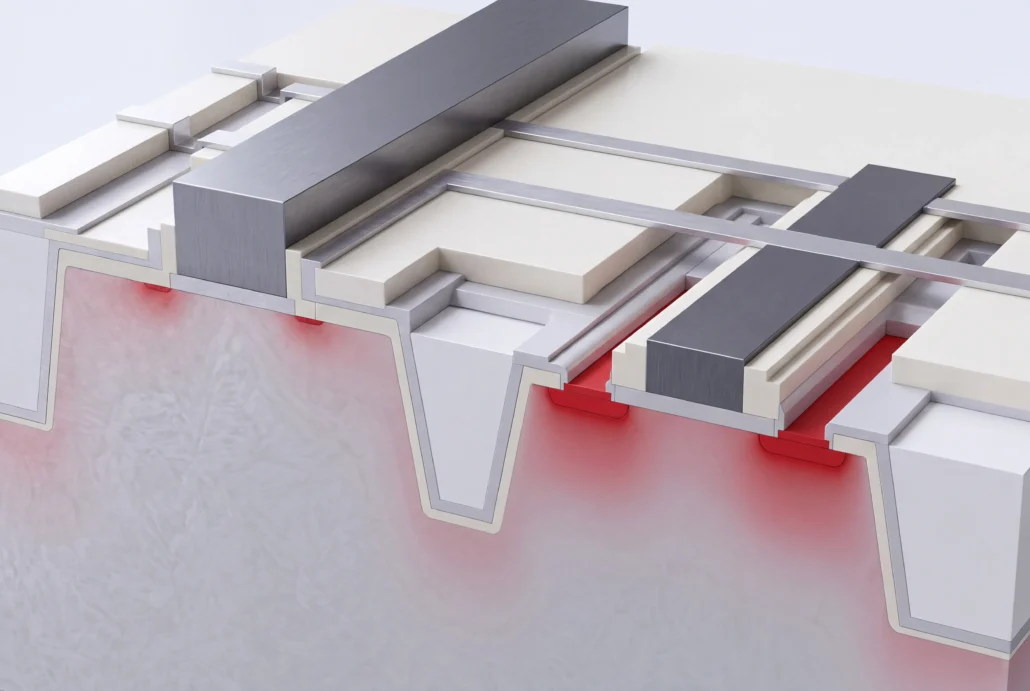
Victory Process: 2D and 3D semiconductor process simulation

Simulate every implant, diffusion, oxidation, deposition and etch step from your GDSII layout, and hand your device simulation a finished 1D, 2D or 3D structure.

What Victory Process does

Victory Process is a process simulator for 2D and 3D work, driven by your layout. It works out what implantation, diffusion, oxidation, deposition and etch do to a semiconductor structure, one step at a time. The learning happens in process simulation, not on test wafers. Adjust a dose or an etch time and you see the resulting structure before you commit a wafer, not when the lot comes back from the fab. Own process integration? That’s where you learn how much one step’s variation matters, before yield tells you.

What you can model

Simulation modes

The move between 1D, 2D and 3D happens automatically. Mask-based simulation reads your GDSII layout directly. What you simulate comes from your real masks, not a cross-section someone drew by hand. Multi-threaded.

Ion implantation

Analytical mode runs experimentally verified Pearson and double-Pearson models, and accepts your own user-defined moments. Monte Carlo mode rests on the Binary Collision Approximation, with universal tilt and rotation, in crystalline or amorphous material. Empirical models handle implant damage.

Diffusion and activation

Impurities diffuse through multi-material structures in 1D, 2D and 3D. You choose the model the problem calls for: Fick, Fermi, Fully Coupled, Five-stream, Single-pair, or grain-based for polysilicon. Transient activation, point-defect trapping and clustering run coupled with oxidation-enhanced diffusion.

Oxidation, deposition and etch

Oxidation runs analytically, empirically via the Massoud model, or fully physically — solving oxygen transport and material flow numerically, with stress, ambient composition, crystal orientation and doping all affecting the rate. Silicon and silicon carbide are calibrated, and there is no restriction on which materials can be oxidised.

Deposition and etch each offer a fast geometrical model for prototyping a structure and full physical models when the shape has to come out of the process: conformal, non-conformal and directional deposition with shading and visibility, ion beam deposition, wet and dry etch with selectivity, ion-enhanced chemical etch and ion milling.

Photolithography and stress

Lithography is modelled from the same GDSII layout: two-dimensional aerial image formation at large numerical aperture, with extensive source and pupil plane filtering, and full phase-shift and transmittance-variation masks.

Stress accumulates the way it does on a wafer — thermal mismatch between layers, local lattice mismatch at interfaces, initial deposit stress, hydrostatic stress from capping layers, and whatever the previous step left behind. Crystalline materials including silicon, SiGe and GaAs are treated anisotropically, accounting for wafer orientation.

Extensibility

If your process depends on physics Victory Process doesn’t ship, add it through the Open Model Interface. New materials and their parameters go into the Open Material Database. You extend the tool rather than wait for a release.

Where Victory Process sits in the TCAD flow

Your GDSII layout goes in. The structure Victory Process builds goes on to four tools.
Fab and process engineers without a TCAD specialist on hand reach the same physics through FTCO.

Takes in

Your layout

GDSII, imported directly

This tool

Builds the structure

Hands off to

Refines the structure

Simulates electrical behavior

Extracts 3D RC parasitics

Runs design-of-experiments sweeps

Applications, by device family

Advanced CMOS

FinFET, FDSOI and bulk CMOS

Display

TFT, LED and OLED

Power and RF

BiCMOS, BCD, SiC and GaN

Optical and photonics

CMOS image sensors, solar cells, lasers, waveguides and modulators

Published work and resources

Every item opens without a form.

New to Victory Process, or already running it

Evaluating it

Bring the device you're actually trying to make: its layer stack, its node, the step that won't match silicon. An application engineer sets Victory Process up on your case, so what you see is your structure, not a prepared example.

Running it

Installers, manuals and release notes are in Support and Downloads.

Stuck on something

Open a case in the support portal and track it until it's closed. Portal access comes with a current maintenance contract.

Questions about Victory Process

What does Victory Process simulate?

Each fabrication step that builds a device, from ion implantation and dopant diffusion and activation through oxidation, deposition and etch. You work in 1D, 2D or 3D from your GDSII layout. The output is a structure file for Victory Device to simulate electrically, often after Victory Mesh has refined the mesh.

Emulation reproduces a structure's shape from geometric rules, which is enough when all you need is the geometry. Simulation works the shape out from the physics instead: how dopants implant and diffuse, how oxide grows, how material deposits and etches. Victory Process simulates; for process emulation, see the TCAD family page.

Yes, through mask-based simulation that reads GDSII directly, so the structure you simulate comes from the mask set you're actually using. When the layout changes, the structure changes with it; there's no cross-section to redraw by hand. That direct import is what makes Victory Process layout-driven.

Analytical implantation rests on experimentally verified Pearson and double-Pearson models, and you can supply your own moments. Monte Carlo implantation runs on the Binary Collision Approximation, handling crystalline and amorphous materials with universal tilt and rotation. For diffusion, choose Fick, Fermi, Fully Coupled, Five-stream, Single-pair or grain-based polysilicon.

It writes a structure file, and Victory Device reads it. Victory Mesh can refine the mesh in between. The same structure goes to Victory RCx for 3D RC extraction, and when you're sweeping a design of experiments, Victory DoE runs the whole sequence.

Other tools in Silvaco TCAD

Victory Device

Victory Atomistic

Victory RCx

Victory Mesh