VSim Plasma
Home » Products & Workflows Hub » AI-Driven Manufacturing » Plasma » VSim Plasma
VSim Plasma: particle-in-cell simulation for plasma processing
Reshape the chamber or the drive waveform in software and read off the energy and angle of the ions reaching your wafer, while the hardware is still a drawing.
What VSim Plasma does
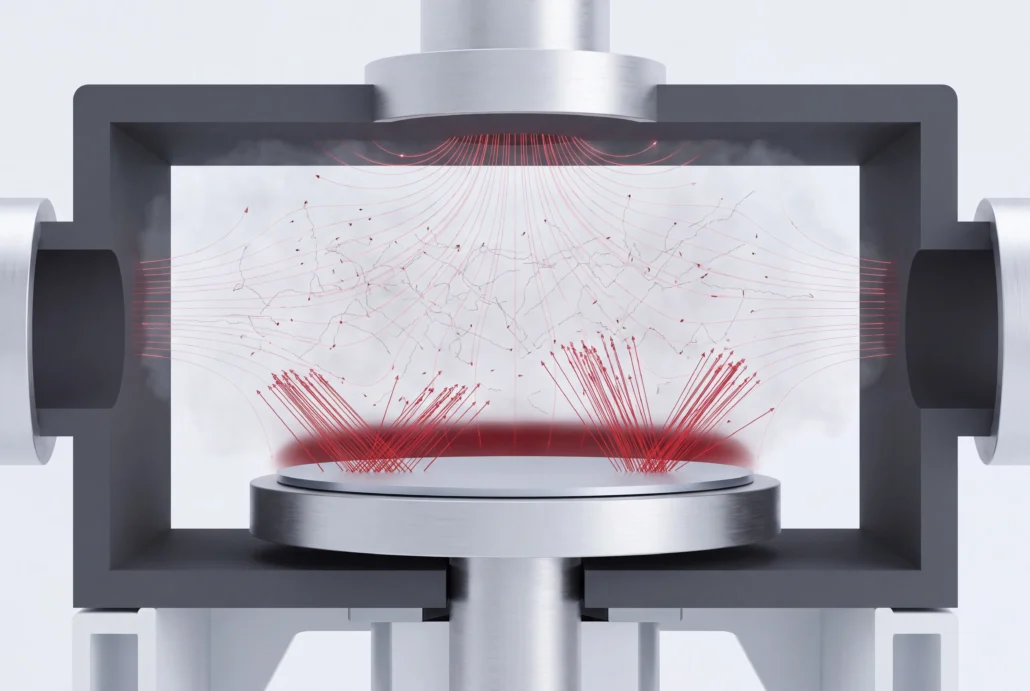
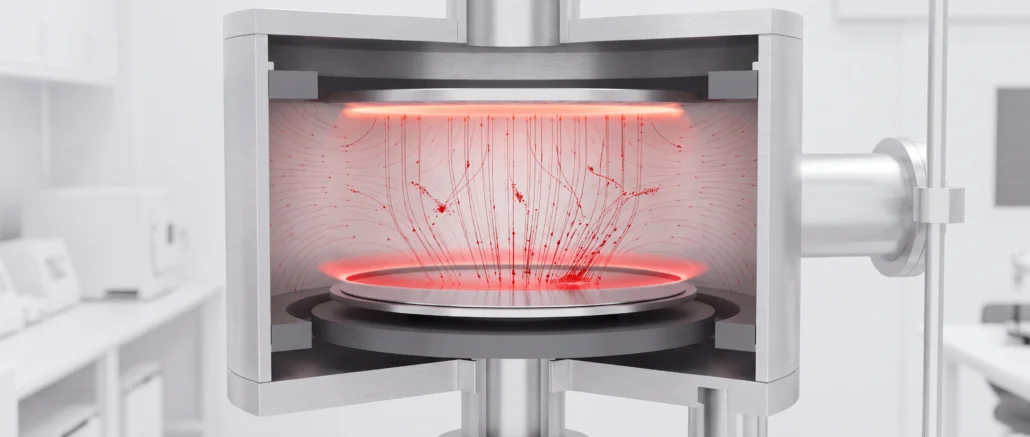
VSim Plasma is particle-in-cell plasma simulation software for the discharge inside your process chamber. Every charged species moves as a particle through background gas at your operating pressure. An FDTD solver computes the electromagnetic fields those particles create, and the collisions and reactions between them decide what finally lands on the wafer. Trying a different chamber or chemistry costs you a rerun instead of a rebuild.
Capabilities
Numerical methods
The kinetic species are pushed as particles in cell, and FDTD solves the fields around them at each step. Monte Carlo collisions and DSMC carry the plasma chemistry. For regions that don’t need the kinetic detail, switch to the charged-fluid, finite-volume option and spend the compute where it counts.
Collisions and reactions
Elastic scattering, excitation and ionization among electrons, ions and neutrals set the shape of the electron distribution. In a working process plasma, that shape is rarely thermal. The reaction set adds sputtering, charge exchange, excitation decay, three-body recombination and three routes to ionization: impact, field and electron.
Geometry and boundaries
Cut-cell algorithms follow a curved wall or focus ring at its true contour instead of a staircase approximation. Set conducting and dielectric materials in any of several dimensionalities, then decide what each boundary does to a particle: absorb it, reflect it, wrap it periodically or let part of the flux through.
Scale
From a laptop to high-performance parallel machines. The code’s record includes national-lab supercomputers.
Two packages on one engine
VSimPD · plasma discharge
The package for semiconductor processing. Magnetron sputtering, DC and capacitively coupled plasmas, ion thrusters and ion sources all fall under it, so one license covers the discharges behind both etch and deposition. Working on a process chamber? Start here.
VSimPA · plasma acceleration
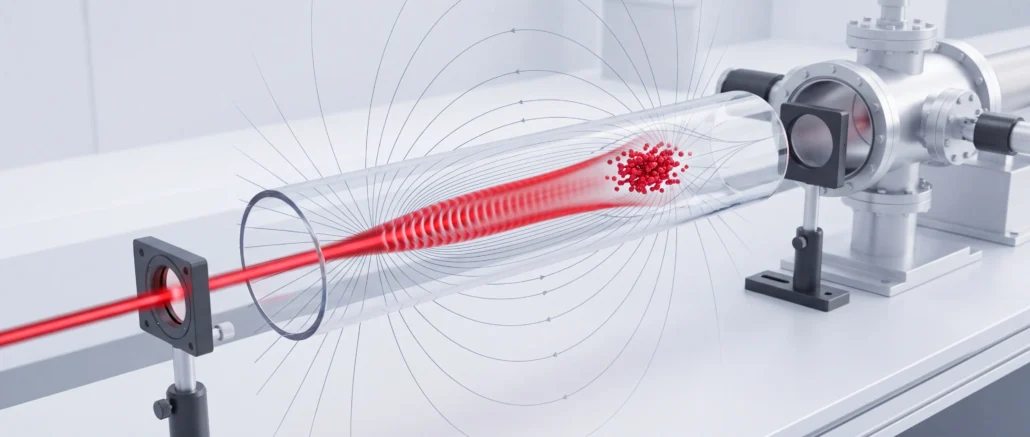
Wakefield acceleration, driven by laser or by electron beam, with ionization injection. It shares VSimPD’s engine but serves plasma-physics research, not the fab.
Works with
Takes in
The chamber geometry, the gas mixture at your process pressure, and the drive conditions. The drive waveform matters more than it looks, because it sets the energy of the ions that do the etching.
Produces
Ion energy and angle distributions at the wafer, plus deposition and erosion profiles for sputtering. Export the distributions as histograms or von Mises-Fisher fits, and Victory Process picks them up to predict the feature-scale profile.
What you can simulate
Plasma wafer etching
Argon ions etching a microelectronics wafer inside a plasma chamber.
Magnetron sputtering
Target erosion and film deposition from a magnetron discharge.
Ion sources
Plasma ion sources, modeled from the discharge outward.
Chamber and reactor design
Compare chamber geometries on how evenly they treat the wafer, with no hardware cut.
Track record and resources
Four supercomputers, one code
The University of Sydney's Artemis, Argonne's Theta, Lawrence Berkeley National Laboratory's Cori and KAUST's Shaheen II have all run VSim. If your chamber model outgrows a workstation, the code has already worked at supercomputer scale.
Try it on the chamber
you actually run
Bring your chamber geometry and the profile problem you can’t close.
That’s the case our engineers model.
Questions about VSim Plasma
What is particle-in-cell plasma simulation?
Particle-in-cell simulation models a plasma as a large population of macro-particles, each standing in for many real ones, moving across a computational grid. Each step, the grid collects their charge, a field solve follows, and the updated fields move the particles. Nothing about the velocity distribution is assumed; it emerges from the run.
When do I need a kinetic model rather than a fluid one?
When the distribution is far from thermal, which is the usual case wherever it counts in a process plasma. Electrons thin out above the ionization and excitation thresholds, and in the sheath neither species is anywhere near equilibrium. A fluid model would assume a temperature exactly where the ions pick up the energy and angle that shape your etch.
Which collision and reaction processes are included?
Collisions among electrons, ions and neutrals cover elastic scattering, excitation and ionization, computed by Monte Carlo collisions and DSMC. Reactions include impact, field and electron ionization, three-body recombination, charge exchange, excitation decay and sputtering. If your chemistry needs a process that isn't listed, ask before you set up the run.
Can VSim Plasma model my chamber geometry?
Yes, that's what the cut-cell method is for. It follows curved walls, focus rings and other chamber features as drawn, in several dimensionalities, with conducting and dielectric regions defined. So you can compare two chamber designs on screen before committing to either one.
Does it run on a cluster or only on a workstation?
Both. It runs on a single workstation and on high-performance parallel clusters, and VSim has run on national-lab and university supercomputers. Before you size hardware for it, check operating system support, GPUs and the license model with our engineers, so the plan matches what ships.
Is there an evaluation license?
Yes. Evaluations run on your own chamber geometry and process conditions, and a Silvaco engineer works through the first setup alongside you. The result then tells you something about your own process, which is the whole reason to run an evaluation.