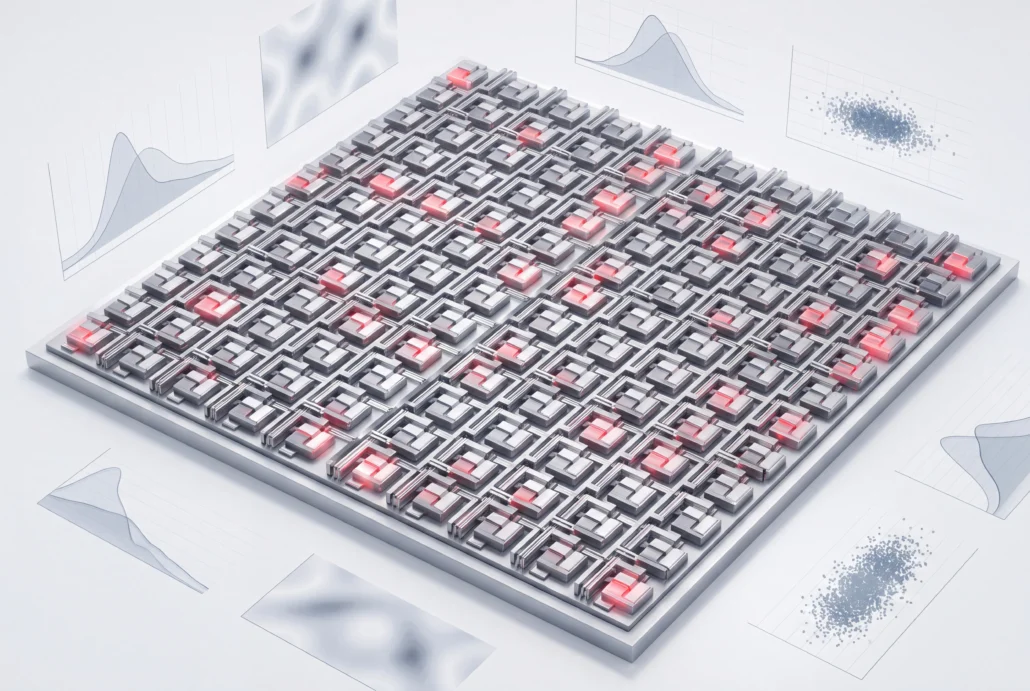
Estimate yield for the whole memory, not a slice of it. VarMan XMA rebuilds the full array and runs Monte Carlo across it, so the yield you report comes from simulation rather than extrapolation.
VarMan XMA runs memory yield analysis on the entire memory, with your golden SPICE simulator doing the work. At full size that’s normally impractical. So the usual workaround simulates a slice or a critical path and projects the result. The projection is where the error comes from. Fast SPICE trades accuracy for runtime, and combining per-block sigma corners can produce a yield the silicon doesn’t match.
Capabilities
The whole memory, held to the accuracy you’d expect from a single-cell run.
Whole-memory analysis
Banks, word-line drivers, local I/O, logic and the controller all go into the run. XMA assembles the memory from those blocks in minutes, then simulates all of it.
Method
VarMan’s Fast Monte Carlo and high-sigma kernels, applied to the whole memory for fast-fail detection and yield estimation. Failures surface up to 100X faster than with classical Monte Carlo analysis.
Validation
Verified on FinFET, FDSOI and planar CMOS foundry processes. XMA runs alongside the golden SPICE simulator in your flow.
Interface
Set up and run the analysis from a graphical interface. Results show the statistical spread behind each yield estimate. You can read them without a statistician on the team.
Works with
You keep your design and your simulator. XMA changes how much of the memory they cover.
Takes in
A memory design and a golden SPICE simulator. The reference-accuracy simulator your team already trusts.
Extends
VarMan, the base product. XMA is an option to VarMan Memory and runs on VarMan’s analysis kernels.
VarMan: variation-aware design for analog, RF, standard cell, I/O and memory teams, with up to 30X the simulation performance of traditional Monte Carlo
Applications
Where a slice-based estimate costs you the most.
SRAM and embedded memory yield estimation
SRAMs and large embedded memories, where one rare bit-cell failure can decide whether a whole instance passes
Full-chip memory yield verification
A yield figure checked across the complete memory before you commit it to silicon
Fast-fail detection across a whole memory
Rare failures located anywhere in the array, with one simulation standing in for many instances
Proof and resources
Check the numbers yourself.
Press release
February 2022
CEA-Leti and Silvaco team up on yield prediction project for ultra-low-power static memories
CEA-Leti chose VarMan XMA for fail detection and yield estimation on a 256 Kb ultra-low-voltage, ultra-low-leakage SRAM. The project planned to test its predictions against silicon from STMicroelectronics' 28 nm UT-FDSOI process.
The SRAM case in numbers. An 8K × 80-bit memory, 100K instances (65,536M equivalent runs), 10,000 simulations, two failures found.
Product brief · PDF
February 2022
VarMan – Statistical Variation and Yield Analyzer
What each VarMan edition analyzes, including the three analyses the XMA option brings to VarMan Memory.
Webinar
February 2022
Memory Statistical Characterization Solution with VarMan
Dr. Jean Baptiste Duluc shows how VarMan's tools, XMA among them, cut the simulation count for high-sigma memory characterization.
Evaluate and engage
Send us a memory design and the yield target it has to hit. An application engineer runs XMA on it with you and walks you through the result for the full memory.
Questions about memory yield analysis with VarMan XMA
What is memory yield analysis?
Memory yield analysis predicts how many manufactured memories will meet spec once process variation is counted in. Because the same bit-cell repeats across the whole array, even a one-in-a-billion failure rate matters. CEA-Leti's XMA project set out to test whether rates that low still guarantee acceptable yield for SRAMs above a megabyte.
Why is analyzing a memory slice not enough?
A slice or critical path leaves most of the memory unsimulated, so the yield figure is extrapolated, and the error can be significant. Fast SPICE cuts runtime at the cost of accuracy, and block-by-block sigma corners can combine into an unrealistic result. XMA simulates the whole rebuilt memory with golden SPICE instead.
Is VarMan XMA a separate product or an option?
An option. VarMan XMA gives VarMan Memory three analyses that span the entire memory: XMA Monte Carlo, XFail analysis and yield verification. They run on the same analysis kernels as base VarMan, which remains the tool for variation work on individual cells and blocks.
Which memory technologies has XMA been verified on?
Three foundry technology families: planar CMOS, FinFET and FDSOI. In 2019, CEA-Leti announced a project applying XMA to a 256 Kb ultra-low-power SRAM, with measured 28 nm UT-FDSOI silicon from STMicroelectronics as the check on its predictions. For a node outside those families, our technical experts can tell you where it stands.
Does XMA work with third-party SPICE simulators?
Yes. XMA works with the golden SPICE circuit simulators used across the industry, so the full memory runs at reference accuracy rather than through a Fast SPICE approximation. Name the simulator your flow depends on, and we'll confirm the setup before you scope an evaluation.
How long does it take to build a full memory analysis?
The build takes minutes, and XMA then keeps the simulation count small. In one SRAM run, 10,000 simulations covered 100,000 instances of an 8K × 80-bit memory, equal to 65,536M individual runs, and found two failures. You get a full-memory yield figure without simulating every instance one by one.