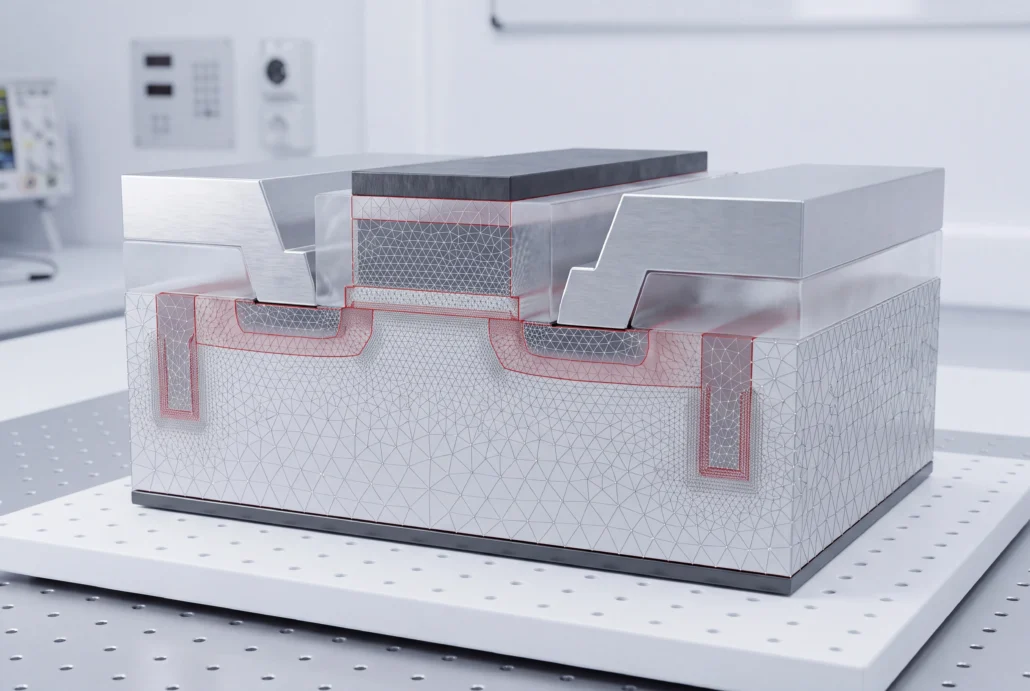
Victory Mesh: TCAD mesh generation and solid modeling

Put mesh resolution where your device physics needs it in any 2D or 3D TCAD structure, and build the structure by solid modeling when there’s no process run to start from.

What Victory Mesh does

Victory Mesh meshes, refines and edits 2D and 3D TCAD structures, and builds new ones by solid modeling. What you get is a mesh fitted to the physics your device or extraction simulation has to resolve. It’s the TCAD mesh generation step between process and device. Feed it the raw geometry and doping from Victory Process, or a structure you built here. You get back a mesh refined for device simulation or 3D parasitic extraction, and the refinement runs automatically to the specification you set.

TCAD mesh generation, refinement and solid modeling

Choose the scheme for the structure in front of you, then aim the refinement.

Meshing schemes

Delaunay meshing is the automatic one. It samples without a fixed grid, refines locally, and shapes the mesh around the materials, interfaces and quantities you tell it to prioritize.

Conformal meshing is the one you specify. You get a semi-structured Cartesian grid, refined along each axis separately, so the grid lines sit exactly where you put them.

Refinement

Eight local refinement schemes for Delaunay meshes, some general and some specific to device work: uniform, impurity, junction, iso-surface, interface, shape, approximation distance and quality.

Aim any of them at particular materials or at attributes you define. That’s how a junction gets fine resolution while the substrate under it stays coarse.

Solid modeling

Generate shapes, transform them, join and crop structures, and add analytic doping profiles. It’s enough to build a device from user-defined shapes with Gaussian doping, or to take an existing one apart.

Typical jobs: mirror part of a symmetric device into the whole thing, stretch a compressed device back to its true dimensions, crop or slice out a region for a closer look, swap regions for simulated polycrystalline grains, or bend an existing structure. Anything you build or edit can be remeshed before you simulate it.

Inputs and outputs

In: Silvaco standard structure files (.str), 2D or 3D, and saved states from Victory Process.

Out: to Victory Device for device physics, to Victory RCx for field-solver RC extraction, or to third-party software as .stl or .vtk. You run it from the Deckbuild interface and can check the result in Victory Visual first.

Where it sits in the TCAD flow

Takes in: a structure from Victory Process, or one you build here by solid modeling.
Hands off to: Victory Device, Victory RCx, or a third-party tool.

In

A structure

From Victory Process, or built here by solid modeling

This tool

Victory Mesh

Meshes, refines, edits

Out

Victory Device

Device simulation

Out

Victory RCx

Field-solver extraction

Out

Third-party tools

.stl and .vtk

Device families you can mesh

Advanced CMOS

Bulk CMOS, PDSOI, FDSOI and FinFET

Power, RF and BCD

Power diodes, IGBTs, thyristors, GaN HEMTs, SiC DMOS and SiC LDMOS

Display

Amorphous-Si and poly-Si TFTs, IGZO TFTs, LEDs, OLEDs and MicroLEDs

Optoelectronics

CCD and CMOS image sensors, avalanche and PiN photodiodes, solar cells

Published work and how-to guides

Every item here opens without a form, the paper included.

Simulation Standard

June 2026

TCAD Breakdown Simulation of a 1200 V Vertical GaN FinFET

Engineers at Dynex Semiconductor rebuilt a vertical GaN FinFET process flow in Victory Process, generated the mesh in Victory Mesh, then simulated breakdown.

Webinar

January 2022

Learn How to Perform Device Meshing with Silvaco's Victory Mesh TCAD Solution

Conformal and Delaunay meshing compared, and how each turns a process structure into a mesh ready for device simulation.

Simulation Standard

April 2022

How Can I Remesh a Structure Using a Custom Volume Mesh in Victory Mesh?

Line statements set the volume grid, shown on a FinFET built by solid modeling and on an LDMOS brought in from Victory Process.

Webinar

February 2021

How To Remesh with Victory Mesh for an Optimized TCAD Device Simulation

From Victory Process structure to device-ready mesh, with conformal and Delaunay refinement on interfaces, junctions, impurities and regions.

Hints and tips

March 2020

How do I Load, Remesh, and Refine an Existing Device Structure in Victory Mesh?

Load one structure file, turn prism elements into tetrahedra, then remesh and refine without rebuilding anything.

Product brief · PDF

Victory Mesh: Meshing and Solid Modeling

Four pages with the capabilities and five worked structures, from a quantum dot to a MicroLED.

Three ways in

Evaluating it

Bring the structure whose mesh you don't trust yet. Evaluations use your device data and come with an application engineer assigned to the case. There's no self-serve trial.

Already running it

Downloads sit in Support and Downloads, with the release notes, manuals and worked examples beside them.

Stuck on something

License holders on a current maintenance contract log cases in the support portal and follow each one to resolution there. Include your refinement settings when you raise one.

Victory Mesh questions

What does Victory Mesh do?

Victory Mesh turns a TCAD structure into a mesh a solver can use. It meshes and refines 2D and 3D structures and edits them by cropping, slicing, mirroring or stretching. It also creates new structures through solid modeling, doping included. The result goes to device simulation or field-solver extraction, and it can be remeshed after every edit.

The mesh decides what the solver can resolve. Leave it coarse at a junction or an interface and the steep gradient that sets device behavior is averaged out of the answer. A uniformly fine mesh isn't the fix. Local refinement concentrates elements at the features that matter and keeps them sparse everywhere else.

Delaunay is automatic and unstructured: it follows the features and refines wherever your chosen materials, interfaces or quantities call for it. Conformal is user-specified, a semi-structured Cartesian grid refined per axis, so the lines stay where you set them. The eight local refinement schemes belong to Delaunay; conformal is for flows that need a predictable grid.

Yes. Solid modeling builds the device directly: generate and join user-defined shapes, insert analytic or Gaussian doping, transform the geometry, then remesh and simulate. Use it for a geometry with no process flow yet. It also suits features such as deep etched trenches and textured solar-cell surfaces, which are slow to reach through process simulation.

It opens Silvaco structure files (.str) in two or three dimensions, along with saved states from Victory Process. Victory Device and Victory RCx both take its output directly, for device physics and field-solver RC extraction respectively. For software outside Silvaco, it exports .stl and .vtk.

Yes. It exports .stl and .vtk, both standard formats that software outside Silvaco reads. A structure you've meshed and refined here can leave the Silvaco flow at that point. From there it goes straight to whatever third-party tool your team already uses for its next step.

The rest of the TCAD suite

Victory Process

Victory Device

Utmost IV

Victory RCx

Victory Atomistic