PEX Certify
Home » Products & Workflows Hub » AI-Driven Design » Analog and Custom IC Design » PEX Certify
PEX Certify: qualify and compare parasitic extraction flows
PEX Certify shows you, net by net, whether your parasitic extraction flow still agrees with itself after a PDK or extractor change, before sign-off depends on it.
What PEX Certify does
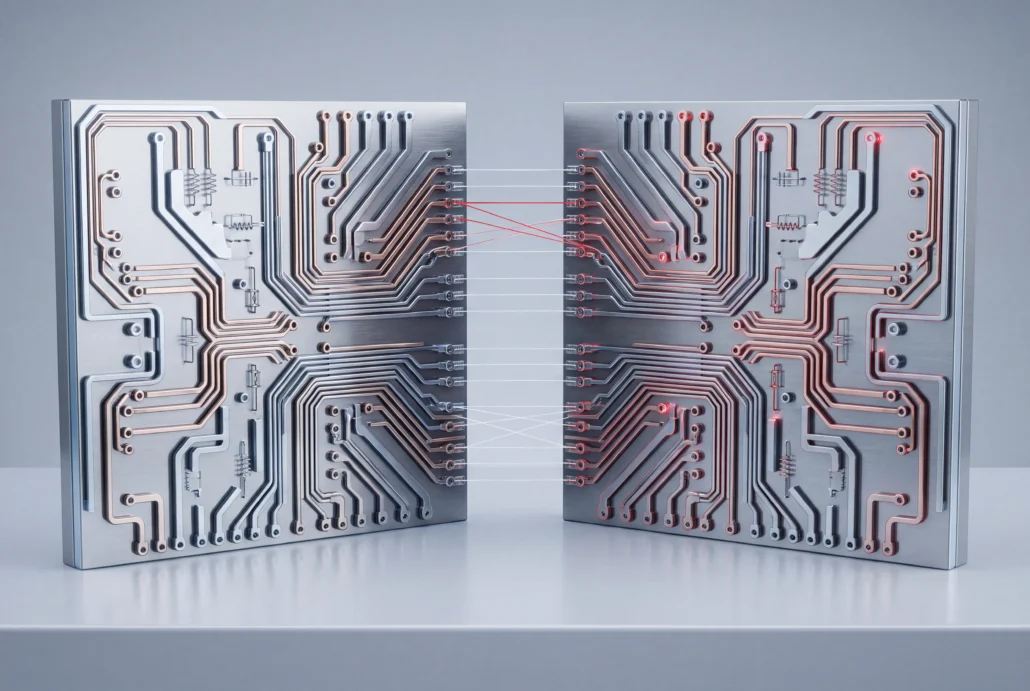
PEX Certify compares two extracted netlists and tells you where they differ, and by how much. You get that answer from the parasitics themselves, without a single circuit simulation. It matters because every new PDK, extractor release or flow setting adds another extraction your team has to trust. And the parasitic network behind each one is too complex to judge by inspection. PEX Certify is two tools working together: PEX Diff compares the parasitics, and PEX Link lines the two netlists up when their names don’t match.
Capabilities
It runs on the netlists your flow already produces, with no test benches to build first.
What it compares
Pin-to-pin resistance and RC delay, net-to-net capacitance, and the statistics across all of them, down to how much each layer contributes.
Device parameters too, so you can confirm the instance section extracted correctly.
Any major ASCII netlist or OpenAccess extracted view, including one format checked against another.
Components
PEX Diff compares the parasitics, matching nets and pins by name.
When names don’t match, PEX Link builds the mapping first. It handles different naming strategies, different delimiters and scrambled fingers. It pairs up every instance, pin and net finger by finger, and it compares device parameters along the way.
Use cases
Two settings of one extractor, two versions of the same extractor, two formats, or two extractors from different vendors.
It also shows what a manual routing change does to insertion delay, with no SPICE run or static timing analysis. And it tracks how wire loads shift when a design moves to a new technology.
Operation
Run it from the command line or the GUI. Batch mode takes over the in-house comparison scripts your team would otherwise have to keep maintaining, and it keeps up with large, complex designs. Results land in ASCII CSV and TSV files your own scripts can read.
Platforms
Red Hat Enterprise Linux 7.9, 8.4 and later, and 9.1 and later. SUSE Linux Enterprise Server 12 SP5, and 15 SP3 and later. All x86_64.
Works with
Two netlists go in. A qualified, quantified list of where they differ comes out.
Takes in
Two extracted netlists. They can be DSPF, SPEF, SPICE or CalibreView parasitic netlists, or OpenAccess extracted views, in the same format or two different ones. When the names don’t line up, add the optional PEX Link mapping file.
Hands off to
The comparison itself, as CSV and TSV files for your scripts and a results database you explore in the GUI.
Viso: dig into the differences PEX Certify found. Used together, they cut weeks from debugging an extraction flow or setting up a new one.
Hipex: or whichever extractor you’re qualifying, so each fix goes back to the settings that caused it.
Applications
LPE flow qualification
Tune the extractor's settings without having to reverse-engineer its algorithms.
PDK and tool version migration
See what moved in the parasitics, and in every wire's load, when the PDK, tool or node changes.
Comparing two vendors’ extraction tools
Different formats and different naming, compared like for like.
Checking the delay impact of a manual routing change
The delay a reroute adds or removes, read straight from the parasitics.
Datasheet, slides and talks
The datasheet has the specs. The talks show the analyses running on real circuits.
Product brief · PDF
February 2022
PEX Certify – Parasitic Extraction Comparison
Two pages on what it compares, what it reads and writes, and where it runs.
Bring two extractions you don't trust yet
Send us two extractions of the same block, from two tools, versions or PDKs.
We’ll walk you through where PEX Certify finds them disagreeing.
Questions CAD teams ask about PEX Certify
What is parasitic extraction qualification?
It's how you prove a parasitic extraction flow gives results you can trust: the output is understood and validated, and different tools, versions or settings agree where they should. Teams rerun it every time the PDK or the extractor changes. PEX Certify does it by comparing extracted netlists directly, not through simple test structures that don't scale.
What is the difference between PEX Diff and PEX Link?
PEX Diff compares two or more extracted netlists on pin-to-pin resistance, RC delay and net-to-net capacitance, lining them up by net and pin name. PEX Link steps in when those names differ. It matches each instance, pin and net at finger level and checks device parameters too, and the pair together is PEX Certify.
Can PEX Certify compare netlists from two different vendors’ tools?
Yes. Comparing extractors from different vendors is one of the main jobs it was built for, next to comparing two versions or two settings of one tool. If the tools name things differently or use different delimiters, PEX Link maps one netlist onto the other first, so PEX Diff compares like with like.
Which netlist formats are supported?
PEX Certify reads DSPF, SPEF and SPICE parasitic netlists, CalibreView parasitic netlists and OpenAccess extracted views. It can also check a netlist in one format against a netlist in another. Results are written to ASCII CSV and TSV, and to a database you browse in the graphical interface.
Does PEX Certify need a circuit simulation to find differences?
No. PEX Certify works on the extracted parasitics directly, using statistics and analysis rather than long circuit simulations to decide whether two netlists match. The same goes for a manual routing change: you get its insertion-delay impact straight from the netlists, with no SPICE or STA needed.
Which platforms does PEX Certify run on?
PEX Certify runs on x86_64 Linux: Red Hat Enterprise Linux 7.9, 8.4 and later, and 9.1 and later, plus SUSE Linux Enterprise Server 12 SP5, and 15 SP3 and later. Both the command-line and graphical versions are available on every one of those releases.