

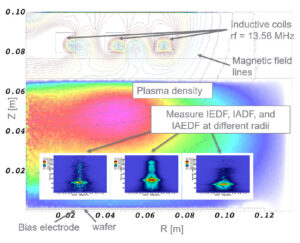
 semiconductor devices, where smaller features, more complex geometries, stricter wafer-uniformity requirements, and new chemistries demand predictive control of ion fluxes at the wafer surface. Kinetic plasma simulation provides a physics-based route to this control by resolving sheath dynamics, ion-neutral transport, and ion angular and energy distributions that cannot be captured reliably with bulk fluid approximations alone. VSim Plasma applies Particle-in-Cell modeling with Monte Carlo collisions to compute self-consistent electromagnetic fields, charged-particle motion, collisions, and current deposition. Validation against inductively coupled plasma measurements shows strong agreement for electron temperature and plasma potential, reasonable density agreement, and consistent electron energy probability function behavior. Coupling plasma-derived ion angular and energy distributions into Victory Process enables feature-scale etch simulation, linking chamber conditions and waveform design to process variability and profile evolution.