Products
Downloads & Support
Licensing
PDK Design Flows
Technical Library
Services
Corporate

Luminous

2D Optoelectronics Device Simulator

Luminous is an advanced device simulator specially designed to model light absorption and photogeneration in non-planar semiconductor devices. Exact solutions for general optical sources are obtained using geometric ray tracing. This feature enables Luminous to account for arbitrary topologies, internal and external reflections and refractions, polarization dependencies and dispersion. Luminous also allows optical transfer matrix method analysis for coherence effects in layered devices. The beam propagation method may be used to simulate coherence effects and diffraction. Luminous is fully integrated within Atlas with a seamless link to S-Pisces and Blaze device simulators, and other Atlas device technology modules.

Luminous can simulate mono-chromatic or multi-spectral optical sources, and provides special parameter extraction capabilities unique to optoelectronics. DC, AC, transient, and spectral optical responses of general device structures can be simulated in the presence of arbitrary optical sources. Luminous is applicable to a wide array of device technologies including CCDs, solar cells, photodiodes, photoconductors, avalanche photodiodes, MSM photodetectors, phototransistors, and optoelectronic imaging arrays and many more.

Charged Coupled Devices and Imaging Devices (CCDs)

Luminous performs detailed analysis of imaging arrays and CCD devices.

A device structure plot of a micro-lens CCD created with Athena. The geometric ray trace data generated by Luminous is overlaid on the structure. Geometric ray tracing capabilities enable the analysis of complex non-planar structures for optimizing collection efficiency and reducing cross-talk. The photogeneration rate is calculated based on the local optical intensity provided by the ray tracing.


Time sequence of electron concentration contours during charge transfer in a buried channel CCD. This type of analysis is used to extract charge well capacity and charge transfer efficiency.
A common application of Luminous is the evaluation of potential in a CCD channel during a transfer cycle. The evaluation of vertical cross-sections at several x-axis locations is used to illustrate the peak potential across the device channel.


High Speed and Communication Photodectors

Luminous analyzes photodetectors used in high speed and low noise applications such as communications hardware. It provides a cost effective solution for optimizing device structures.

Impact ionization rate contours at operating bias for a Reach Through Avalanche Photodiode (RAPD). An important feature of this device is the n-type guard ring that is used to prevent premature breakdown at the edges of the front surface n-region.

The peak impact ionization region is in the intended multiplication region. Luminous enables easy evaluations of different device structures and guard ring geometries.

Important device characteristics such as quantum efficiency, spectral response, and frequency response are easily extracted using Luminous. Shown is the response to a high frequency variable light source. Luminous also permits simulation of transient response. Here the lag between a rapid turn-off of the light and the resultant photodetected current.
Luminous allows the specification and simulation of multi-layer anti-reflective coatings. Shown is a comparison of the spectral response of a device with and without anti-reflective coatings as compared to the ideal response. Luminous allows very general specification of the optical source. In this example we show a Gaussian source intensity, with non-normal incidence and periodic boundaries.


Solar Cells

Solar cell characteristics such as collection efficiency, spectral response, open circuit voltage, and short circuit current can be extracted with Luminous.

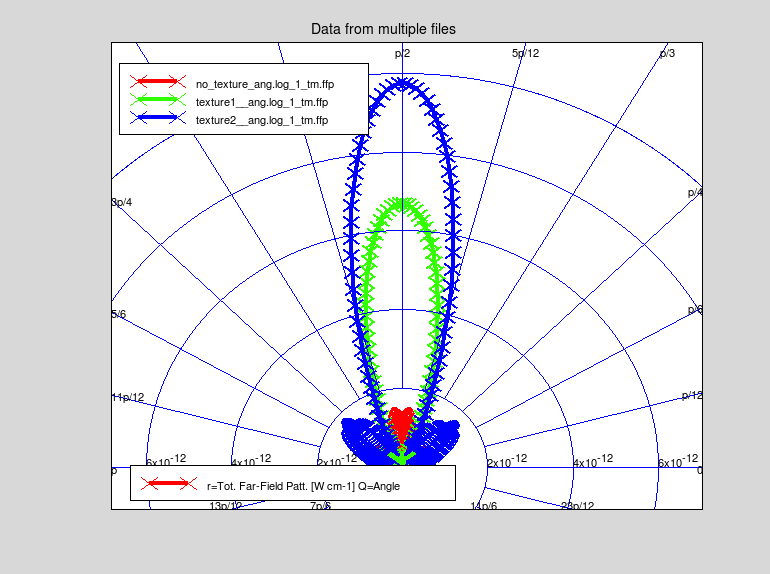
By varying the incident wavelengths, a spectral response can be modeled. The green curve is the current from the light source, and the blue curve is the actual terminal current. The ray trace features in Luminous enable the analysis of advanced designs. Shown above is the simulation of photogeneration rates from an angled light beam.


Beam Propagation Method

Luminous includes physical models that take into account the wave nature of light. Diffraction of light as well as coherent effects can be analyzed using beam propagation method.

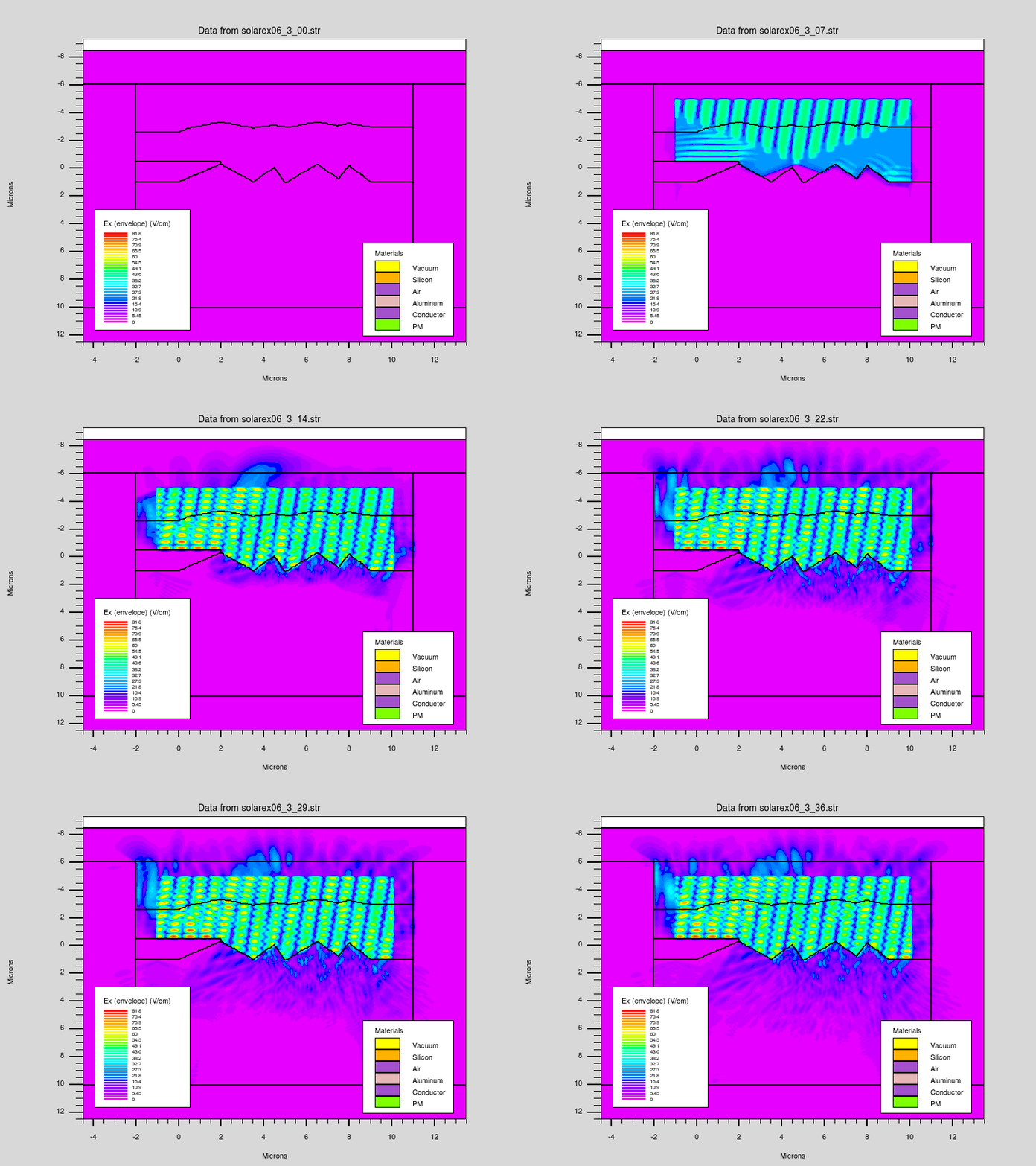
Beam propagation method in Luminous takes into account diffraction of light. Spreading of a narrow Gaussian beam due to diffraction affects the distribution of photogenerated carriers in Silicon.
Beam propagation method in Luminous can be used for analysis of light propagation in complex structures. Light reflection and refraction on a Silicon oxide / Silicon boundary is shown in this figure. Interference of incident and reflected light is taken into account.


High Intensity Optical Beams for Rapid Thermal Annealling Applications

Optical beams are used in semiconductor processing for rapid thermal anneals of whole wafers using infraread lamps or for localized re-crystalization using a high intensity laser beam swept across the wafer in a raster fashion.

Both of these applications can be simulated directly using Luminous in conjunction with Giga to model the temperature rise from the optically stimulated electron-hole pair recombination processes.

The examples on this page depict the transient localized temperature evolution of a high intensity laser beam being swept across the surface of a silicon substrate in the Z direction.

The first two figures show the evolution of temperature rise as the the 10um wide, 1MW/cm2 green laser beam is illuminated for 5 and 10 microseconds respectively. After 10 microseconds the beam is switched off to simulated it being swept in the Z direction, and the final two graphics show how the heat dissipates with time in 5 microsecond intervals. Temperature rise at the surface of the wafer at the center of the laser beam track. After 10 microseconds, the laser beam passes on and the surface of the wafer cools back to ambient temperature.


2D Ray tracing Performance (180000 User Defined Rays)

No. of Processors Time (min) Speed Improvement
1 processor 66.0 min
2 processors 40.7 min 1.62
3 processors 27.4 min 2.4
4 processors 21.6 min 3.05
5 processors 18.6 min 3.55
6 processors 16.5 min 4
7 processors 15.6 min 4.23
8 processors 14.5 min 4.55

Rev. 081809_05

Copyright © 1984 - SILVACO, Inc. - Trademarks - Privacy Policy
facebook youtube twitter

Victory Process

3D Process Simulator

Victory Process is a general purpose 3D process simulator. Victory Process includes a complete process flow core simulator and three advanced simulation modules: Monte Carlo Implant, Advanced Diffusion and Oxidation, and Physical Etch and Deposit.

Victory Cell

3D Process Simulator For Large Structures

Victory Cell is a fast, layout-driven 3D process simulator specifically designed for large structures.

Athena

Process Simulation Framework

Athena framework integrates several process simulation modules within a user-friendly environment provided by Silvaco TCAD interactive tools.

SSuprem 4

2D Core Process Simulator

SSuprem4 is a 2D process simulator that is widely used in the semiconductor industry for design, analysis and optimization of various fabrication technologies.

MCImplant

Advanced Monte-Carlo Implantation Simulator

MCImplant is a generic ion implantation simulator, which models ion stopping, defect generation, and ion implantation distributions in amorphous and crystalline materials.

Elite

Advanced Physical Etching and Deposit Simulator

Elite is an advanced 2D topography simulator for modeling physical etching, deposition, reflow and CMP planarization processes for modern semiconductor technologies.

MC Etch & Deposit

2D Monte Carlo Deposition and Etch Simulator

MC Deposit/Etch is an advanced topology simulation module seamlessly interfaced with Elite through the ATHENA framework.

Optolith

Advance 2D Optical Lithography Simulator

Optolith is a powerful non-planar 2D lithography simulator that models all aspects of modern deep sub-micron lithography: imaging, exposure, photoresist bake, development and reflow.

Athena 1D

1D Process Simulator

Athena 1D is a 1D mode of operation of the industry standard Athena 2D Process Simulator.

Victory Device

3D Device Simulator

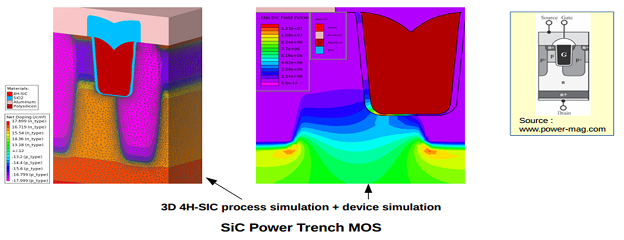
Victory Device is a general purpose 3D device simulator. A tetrahedral meshing engine is used for fast and accurate simulation of complex 3D geometries.

Device 3D

3D Device Simulator

Device3D is a physics based 3D device simulator for any device type and includes material properties for the commonly used semiconductor materials in use today.

Giga 3D

3D Non-Isothermal Device Simulator

Giga3D module extends Device3D by incorporating the effects of self-heating into a device simulation.

MixedMode 3D

Circuit Simulation for Advanced 3D Devices

MixedMode 3D is a circuit simulator that includes physically-based 3D devices in addition to compact analytical models.

Quantum 3D

3D Simulation Models For Quantum Mechanical Effect

Quantum 3D provides a set of models for simulation of the various effects of quantum confinement and quantum transport of carriers in semiconductor devices.

Luminous 3D

3D Optoelectronic Device Simulator

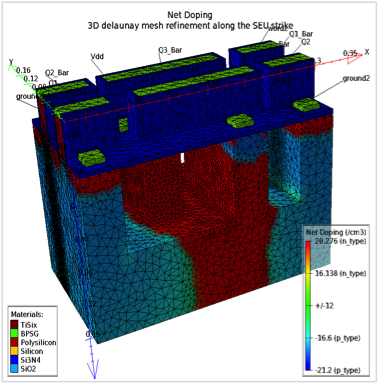
Luminous 3D is an advanced simulator used to model absorption and photogeneration in semiconductor devices with arbitrary topology in three dimensions.

TFT 3D

3D Amorphous and Polycrystaline Device Simulator

TFT 3D is an advanced device technology simulator equipped with the physical models and specialized numerical techniques required to simulate amorphous or polysilicon devices in 3D.

LED 3D

3D Light Emitting Diode Simulator

LED 3D is a module used for simulation and analysis of light emitting diodes. LED 3D is integrated in the ATLAS framework and allows simulation of electrical, optical and thermal behavior of light emitting diodes in 3D.

Magnetic 3D

3D Magnetic Device Simulator

Magnetic 3D module enables the ATLAS device simulator to incorporate the effects of an externally applied magnetic field on the device behaviour.

Thermal 3D

Thermal Packaging Simulator

Thermal 3D is a general heatflow simulation module that predicts heatflow from any power generating devices (not limited to semiconductor devices), typically through a substrate and into the package and/or heatsink via the bonding medium.

Atlas

Device Simulation Framework

Atlas enables device technology engineers to simulate the electrical, optical, and thermal behavior of semiconductor devices.

S-Pisces

2D Silicon Device Simulator

S-Pisces is an advanced 2D device simulator for silicon based technologies that incorporates both drift-diffusion and energy balance transport equations.

Blaze

2D Device Simulator for Advanced Materials

Blaze simulates devices fabricated using advanced materials. It includes a library of binary, ternary and quaternary semiconductors.

Giga

Non-Isothermal Device Simulator

Giga combined with S-Pisces and Blaze device simulators allows simulation of self heating effects.

MixedMode

Circuit Simulation for Advanced 2D Devices

MixedMode is a circuit simulator that includes physically-based devices in addition to compact analytical models.

Quantum

2D Simulation Models for Quantum Mechanical Effects

Quantum provides a set of models for simulation of various effects of quantum confinement and quantum transport of carriers in semiconductor devices.

Luminous

2D Optoelectronics Device Simulator

Luminous is an advanced device simulator specially designed to model light absorption and photogeneration in non-planar semiconductor devices.

TFT

2D Amorphous and Polycrystalline Device Simulator

TFT is an advanced device technology simulator equipped with the physical models and specialized numerical techniques required to simulate amorphous or polysilicon devices including thin film transistors.

LED

2D Light Emitting Diode Simulator

LED is a module used for simulation and analysis of light emitting diodes.

Organic Display

OLED and OTFT Organic Display Simulator

Organic Display module enables ATLAS to simulate the electrical and optical properties of organic display devices such as OTFTs and OLEDs.

Organic Solar

Organic Solar Cell and Photodetector Simulator

Organic Solar module enables ATLAS to simulate the electrical and optical properties of organic solar cell devices, photodetectors and image sensors.

Laser

Semiconductor Laser Diode Simulator

Laser is the world’s first commercially available simulator for semiconductor laser diodes.

VCSEL

Vertical Cavity Surface Emitting Laser Simulations

VCSEL is used in conjunction with the ATLAS framework to produce physically based simulations of vertical cavity surface emitting lasers (VCSELs).

Noise

2D Small-Signal Noise Simulator

Noise combined with S-Pisces or Blaze allows analysis of the small-signal noise generated within semiconductor devices.

Ferro

Ferroelectric Field Dependent Permittivity Model

Ferro has been developed to combine the charge-sheet model of FET with Maxwell’s first equation which describes the properties of the ferroelectric film.

Magnetic

2D Magnetic Device Simulator

Magnetic module enables the ATLAS device simulator to incorporate the effects of an externally applied magnetic field on the device behavior.

Mercury

Fast Simulation of FETS

Mercury is an ATLAS module optimized for the fast simulation of FETs. Mercury is physics-based and so can be used for the predictive simulation of devices.

MC Device

2D Monte Carlo Device Simulator

MC Device simulates the behavior of relaxed and strained silicon devices including non-equilibrium and ballistic effects in 2D.

Victory Stress

3D Stress Simulator

Victory Stress is a generic 3D stress simulator designed to calculate stresses, strains and mobility enhancement for 3D structures as well as stress evolution during multiple step process flows.

DeckBuild

Interactive Deck Development and Runtime Environment

DeckBuild is an interactive runtime and input file development environment within which all Silvaco’s TCAD and several other EDA products can run.

MaskViews

Integrated Layout Editor

MaskViews is a simple to use, yet powerful layout editor that can read, write, create and edit layout files in either GDS2 or Silvaco’s layout format.

DevEdit

Structure and Mesh Editor

DevEdit can be used to either create a device from scratch or to remesh or edit an existing device.

TonyPlot

1D/2D Interactive Visualization Tool

Tonypolot is a powerful tool designed to visualize TCAD 1D and 2D structures produced by Silvaco TCAD simulators. TonyPlot provides visualization and graphic features such as pan, zoom, views, labels and multiple plot support.

TonyPlot 3D

3D Interactive Visualization Tool

TonyPlot 3D is a powerful graphics tool, capable of displaying 3D TCAD data generated by Silvaco TCAD process or device simulators and Silvaco's 3D parasitic products.

VWF

VIRTUAL WAFER FAB

VWF is software used for performing Design of Experiments (DOE) and Optimization Experiments. Split-lots can be used in various pre-defined analysis methods.

Gateway

Schematic Editor

Gateway supports both flat and hierarchical designs and can be used to create designs for both analog and digital. Gateway is fully integrated into our analog and digital simulators.

SmartSpice

Analog Circuit Simulator

SmartSpice delivers the highest performance and accuracy required to design complex high precision analog circuits, analog mixed-signal circuits, analyze critical nets, characterize cell libraries, etc.. SmartSpice is compatible with popular analog design flows and foundry-supplied device models.

Verilog-A Language

Source, Compiled and Encrypted

The Verilog-A language when combined with SmartSpice can provide circuit designers the ability to write custom models and verification of complex designs.

SmartSpice RF

Frequency and time domain RF circuit simulator

SmartSpice RF combines Time-Domain Shooting and Frequency Domain Harmonic Balance methods to provide accurate simulation of RF circuits.

Harmony

Analog/Mixed-Signal Simuator

Hamony is an analog/mixed signal simulator that provides all the capabilities of SmartSpice and Silos and through this give the accuracy, performance, capacity and flexibility to simulate circuits expressed in Verilog, SPICE, Verilog-A and Verilog-AMS.

Utmost III

Device Characterization and modeling

Utmost III generates accurate, high quality SPICE models for analog, mixed-signal and RF applications.

Utmost IV

Optimization Module for Compact/Macro-Modeling

Generates accurate, high quality SPICE models that can be used in analog, mixed-signal and RF simulators.

Spayn

Statistical Parameter and Yield Analysis

Spayn is a statistical modeling tool for analyzing variances from model parameter extraction sequences, electrical test routines, and circuit test measurements.

Expert

Layout Editor and Viewer

Expert is a high performance hierarchical IC layout editor with full editing features, large capacity and fast layout viewing.

Guardian

DRC/LVS/NET Physical Verification

Guardian provides interactive and batch mode verification of analog, mixed signal and RF IC designs.

Hipex

Full-Chip Parasitic Extraction

Hipex is an accurate and fast full-chip hierarchical extraction software that performs extraction of parasitic capacitances and resistances from hierarchical layouts.

Clarity RLC

RLC Netlist Reduction

Clarity RLC is an efficient and accurate tool that performs reduction of linear parasitic RLC elements in extracted netlists. Tool is based on Scattering-Parameter-Based Macromodeling and Time Domain methods.

Exact

Full Chip LPE Rule File Generator

Exact delivers the most accurate interconnect models for nanometer semiconductor processes and generates full chip layout parameter extraction (LPE) rule files.

Quest

3D RF Passive Device Modeling

Quest calculates 3D frequency dependent inductance, resistance, capacitance and capacitive loss for any multi-port network for RF SPICE analysis.

Clever

RC Extractor for Realistic 3D Structures

Clever is a physics-based RC extractor that uses GDSII mask data and process information to create a realistic 3D structure for MEMS, advanced CMOS, TFT, Memory cells, etc., using its built-in etch/deposit processor and optolithographical simulator.

Stellar

3D Physics-Based RC Extractor for Large Cells

Stellar fills the size gap between typical small cell field solvers and full chip extractors.

Silos

Verilog Simulator

Silos is an easy-to-use IEEE-1364-2001 compliant Verilog simulator used by leading IC designers. An industry standard since 1986, its powerful interactive debugging features provide today’s most productive design environment for FPGA, PLD, ASIC and custom digital designs.

HyperFault

Mixed-Level Fault Simulator

HyperFault is a Verilog IEEE-1364-2001 compliant fault simulator that analyzes test vectors’ ability to detect faults. Supports mixed levels of gate, behavioral, and switch with SDF timing.

AccuCell

Cell Characterization and Modeling

AccuCell is an accurate, automated, fast and flexible software tool for characterizing and validating standard cell, I/O and custom cell libraries.

AccuCore

Block Characterization, Modeling and STA

AccuCore performs timing characterization of multi-million device circuits with SmartSpice accuracy and performs block and full-chip Static Timing Analysis (STA) on multi-million gate designs.

Catalyst AD

SPICE Netlist to Verilog Gates Converter

Catalyst AD is the premier tool for converting transistor-level designs into verilog gate-level representations with applications in microprocessor, DSP, graphics and high-speed communication markets.

Catalyst DA

Verilog Netlist to SPICE Netlist Converter

Catalyst DA is a software program that translates a structural Verilog netlist into equivalent SPICE format netlist to be used for layout verification or SPICE simulation.

Spider

Place and Route Design Flow

Spider is a netlist-to-GDSII place and route design flow for mainstream physical design and implementation.