|
||||||||||||||||||||||||||||||||||||||
|
||||||||||||||||||||||||||||||||||||||
|
Home
Products
Overview
TCAD
Overview
Process Simulation
Device Simulation
3D
Stress Simulation
Interactive Tools
Analog,
Mixed Signal, RF Custom IC CAD
Interconnect
Modeling Digital CAD
Product Examples
Downloads & Support
Licensing
Overview
TCAD Unlimited
Universal Tokens
Token Card
TCAD Omni
Term-Based
Perpetual
EDA Academic Suite
PDK Design Flows
Overview
Available PDKs
Foundry Partners
Quality and Testing
Maintainability
PDK Development Services
Documentation & Training
Migration to Silvaco PDKs
Technical Library
Services
Overview
TCAD Services
SPICE Modeling
Parasitic Extraction
PDK Development
Cell Libraries and Blocks
Corporate
|
Device 3D3D Device SimulatorDevice 3D is a physics based 3D device simulator for any device type and includes material properties for the commonly used semiconductor materials in use today. The physical phenomenon that can be simulated self consistently with the semiconductor equations include photon absorption, photon emission, bulk and interface traps, magnetic fields, self heating, ionizing radiation strikes, hot carrier and tunneling effects. This allows simulation of devices such as solar cells, CMOS sensors, LEDs, TFTs, EPROMs, aggressive technology CMOS and power devices. Device 3D uses a simple, intuitive and flexible syntax and runtime environment together with excellent 2D and 3D visualization tools compliment this powerful product. Nano Scale DevicesFin FETs, nano wire FETs and standard FETs at aggressive technology nodes all can be simulated using Device3D. Fin FETFin FET example created directly using Device 3D syntax, showing doping electron distribution and IV characteristics using both drift-diffusion and Bohm Quantum Potential 3D models.
![]() Id/Vg characteristics comparing drift-diffusion and Bohm Quantum Potential (BQP) solutions.
Nano Wire FETA recent addition to the Quantum modeling capability has enabled simulation of the strong quantum confinement effect in quantum wire devices. To model the effects of quantum confinement, Quantum 3D allows a self-consistent solution of the 1D or arbitrary shape 2D Schrodinger and 3D Poisson equations.
Contours of electron wavefunctions on the surface
of 3D structures, found by 1D (left) and 2D (right) Schrodinger equation
solved self-consistently with 3D Poisson equation.
![]()
Device schematic (top left), isosurface of total current
density (bottom) and isosurface of electron density (top right) of a 3D
silicon nanowire FET
with flared-up source and drain regions, computed with coupled mode space
NEGF approach.
![]() Schematics (left) and I-V characteristics (right)
of a Si nanowire transistor with uniform channel cross-section, computed
with uncoupled mode space NEGF approach.
Aggressive Geometry 50nm MOSFETIn this example, the 50nm MOSFET structure was created using “Victory-LD” (Victory Large Device). Victory-LD is a process simulator option that allows creation of Device3D compatible structures following arbitrary shape mask layout driven 3D process simulation. The mask set, process simulated shape, converted Device 3D structure and electrical characteristics are shown below.
![]() Converted ATLAS structure with and without gate spacer.
Quantum Well AnalysisAnalysis of bound states and wave functions are possible
in 3D quantum devices. Here, analysis for a single quantum well and a triple
quantum well design are
shown as examples. SQW Analysis
3QW Analysis
GaN/InGaN/GaN single Quantum Well (QW) and delta
sandwiched QW quantization.
Memory DevicesHot carrier injection and tunnelling models allow the injection of charge
on to floating gates, necessary for the simulation of memory devices. An EPROM
example is shown below.
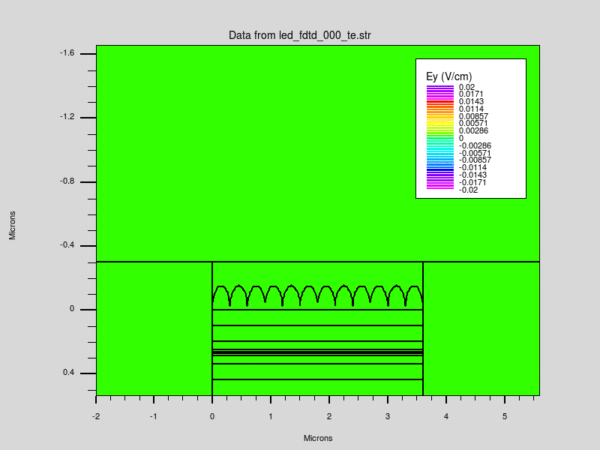
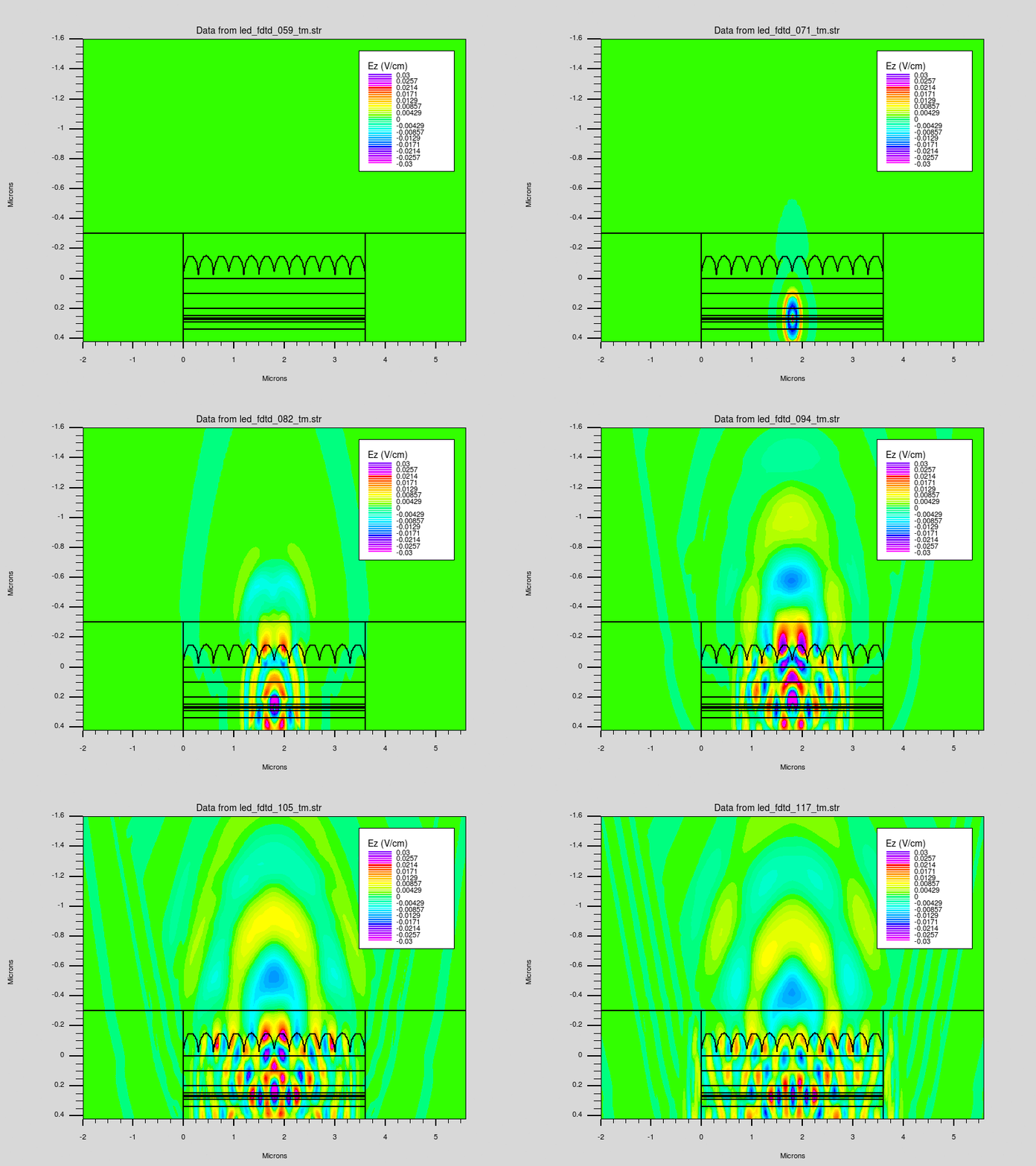
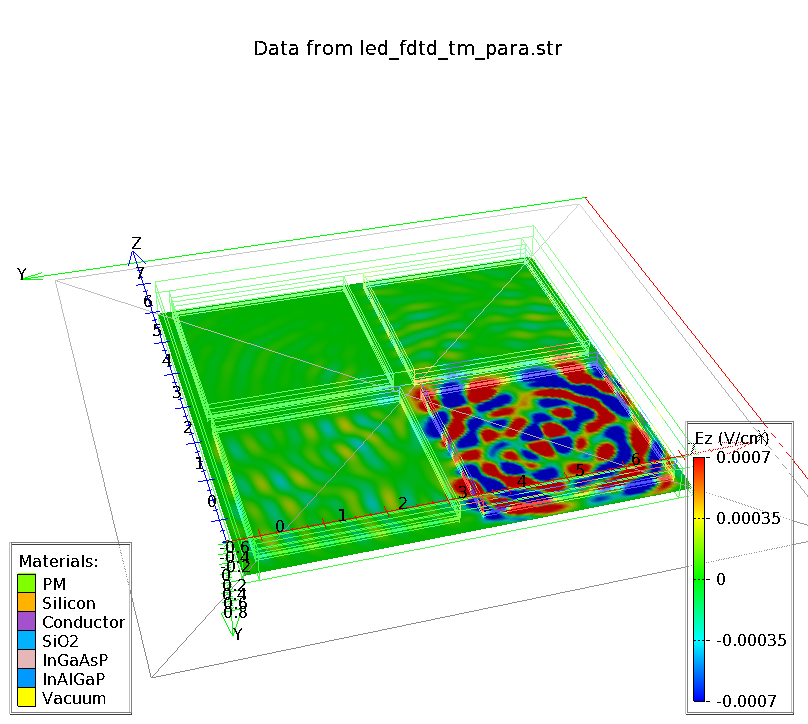
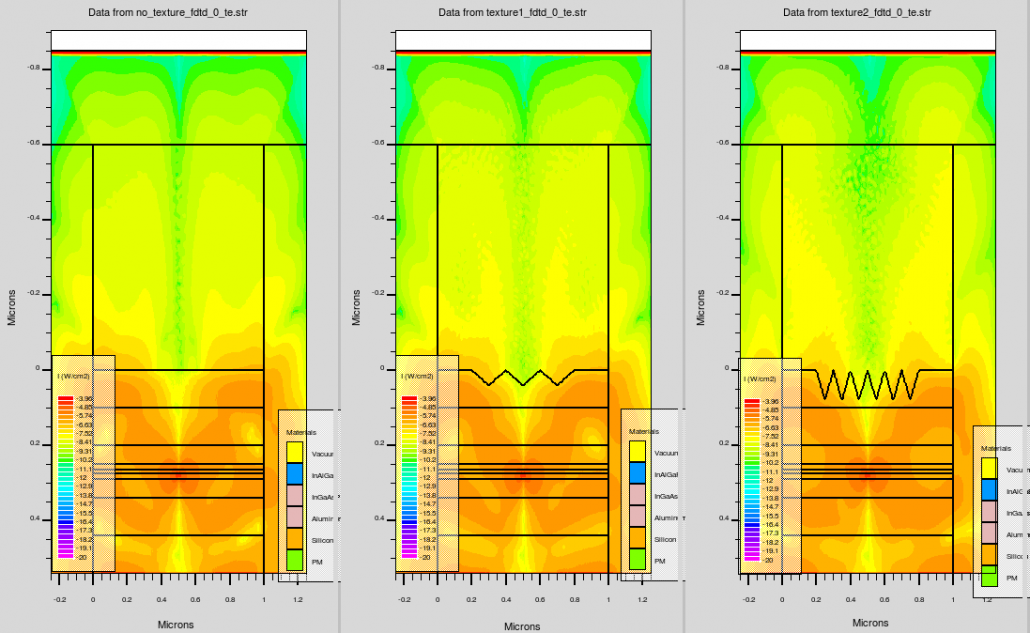
Opto-ElectronicsRay tracing, optical absorption and optically generated carriers are solved self consistently with all other semiconductor equations allowing simulation of light absorbing devices such as photo-diodes and CMOS sensors. Photon generation equations also allow simulation of optically emitting devices such as light emitting diodes (LEDs). Photodiode Simulation
CMOS Simulation
GaN LED Simulation
![]() ![]()
Radiative Recombination Rate distributions
Thin Film TransistorsThe electrical characteristics of thin film transistors (TFTs) are dominated by the existence of bulk and surface traps. In Device 3D these defects can be described as a continuum of defects throughout the bandgap, or can be specified individually. The insulating substrates that these devices are fabricate on (usually glass), are often poor conductors of heat. The additional modelling of self heating effects can often have a considerable effect on device electrical characteristics. ![]() Octagonal array of TFT elements. The contacts and
the SiO2 layers have been made transparent so that the amorphous Si element
can be seen more clearly.
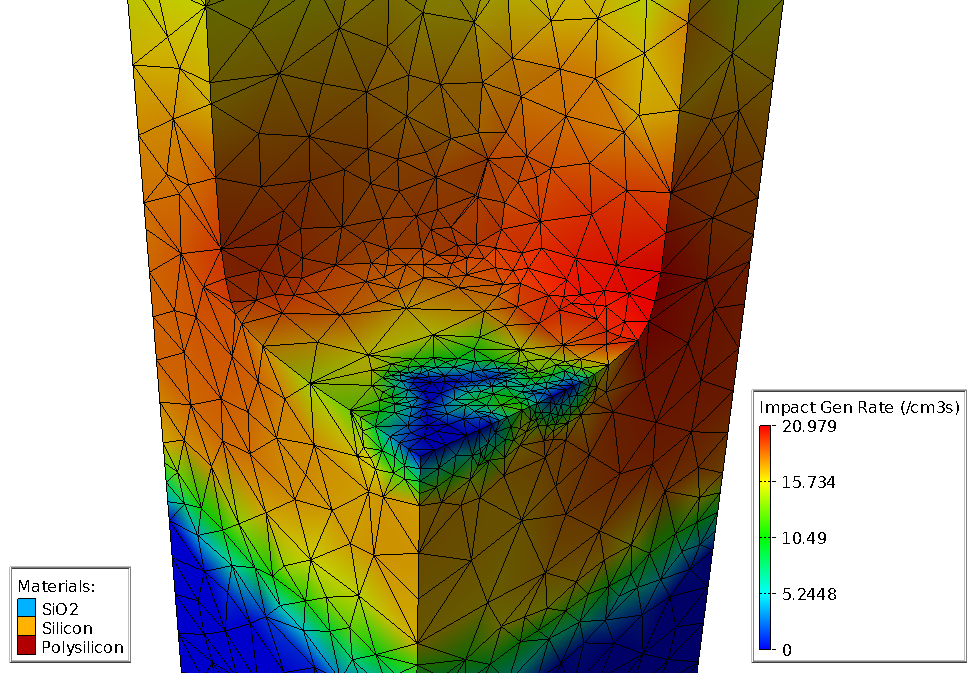
Power DevicesUnderstanding the operation of power devices is an excellent application for 3D TCAD device modelling. Power devices, such as thyristors and triacs etc, often have electrical characteristics dominated by semiconductor phenomenon that occurs deep in the bulk silicon of the device which is difficult to probe directly with measurements. 3D TCAD simulation allows analysis of exactly what is going on throughout the whole device and any time instant during switching transients etc. Below is an example of a UMOS HexFET simulation.
Adding External Circuit ElementsPower devices are often tested and characterized with other connected passive load elements. Here a bipolar transistor is tested with lumped elements attached to it’s terminals. ![]() Mixed device and circuit element simulation
![]() Maximum device temperature and base current as a
function of time
Self HeatingA number of power devices heat up considerably during normal operation. Simulation of self heating effects can detect possible hot spots in your design. Here a simple resistor is used to demonstrate heating effects. Self heating effects can be modeled for any arbitrary device. ![]() Temperature plot at the surface of the passivation
oxide due to thermal heating of a buried interconnect aluminum line
External Heat FlowOnce the thermal output of the power devices has been analyzed at a device level, individual or numerous power devices sharing a common heat sink or package can be analyzed as simple heat sources using the Thermal 3D simulator in order to gauge how hot the package will get after final installation. ![]() GaN HEMT device fabricated onto a Silicon Carbide
substrate mounted onto a copper heat sink
Rev. 052008_05 |
|||||||||||||||||||||||||||||||||||||
|
Copyright © 1984 -
SILVACO, Inc. -
Trademarks - Privacy Policy
|
||||||||||||||||||||||||||||||||||||||